

 Written by
 Agentic AI 2026: Why It’s Creating Jobs, Not a Jobless Boom
In 2026, the phrase Jobless Boom 2026 is attracting attention across financial media and social feeds. At first glance, it sounds alarming — how can economies grow while jobs stagnate? The truth is that work is not disappearing; it is shifting.
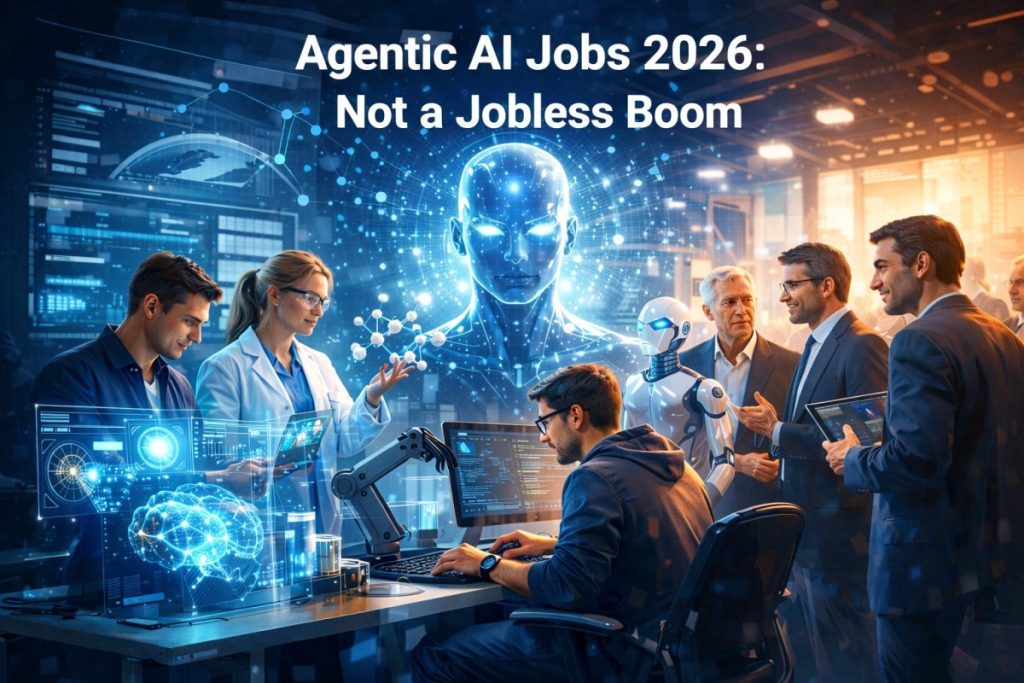
The main driver of this shift is agentic AI, advanced systems that act autonomously to complete complex tasks. Unlike earlier automation waves, agentic AI can make decisions, plan actions, and execute workflows independently. This is reshaping how companies hire, how labor is valued, and how productivity grows.
Despite concerns about a jobless boom, Agentic AI Jobs are in high demand. Companies are aggressively hiring for roles from machine learning engineers to data scientists, even as broader job growth slows in other sectors. Understanding this paradox requires examining how agentic AI transforms work and hiring.
Agentic AI Jobs: Understanding How They Work?
Agentic AI Jobs involve working with autonomous systems that can take a goal and complete it with minimal human intervention. These systems go beyond tools that simply suggest actions or speed up tasks. Instead, agentic AI can plan, make decisions, and execute workflows independently.
For example, given a business goal like improving customer retention, an agentic AI can:
-
Analyze customer data
-
Develop retention strategies
-
Create personalized messaging
-
Deploy campaigns
-
Evaluate results
All of this happens without step-by-step human instructions. This autonomy allows companies to automate workflows while reducing the need for some traditional roles. Professionals in Agentic AI Jobs focus on designing, supervising, and optimizing these intelligent systems rather than performing repetitive tasks themselves.
Agentic AI Jobs: Driving Productivity in 2026
Agentic AI boosts productivity by acting as a digital workforce that operates continuously and at scale. These systems work 24/7, adapt based on results, and automate complex workflows that once required large human teams. As a result, companies can increase output without expanding traditional headcount.
A clear real-world example is landing AI agentic document extraction. Instead of employees manually reviewing contracts, invoices, or regulatory documents, agentic AI systems can extract key data, understand context, validate accuracy, and route decisions automatically. What once took days of human effort now happens in minutes, turning document-heavy processes into fast, automated pipelines.
Because of this shift, agentic AI jobs are expanding in areas such as implementation, oversight, and optimization. Companies increasingly hire professionals to design agent workflows, train document intelligence systems, and monitor performance to ensure accuracy, compliance, and reliability. While routine data-entry and repetitive processing roles decline, higher-value roles focused on AI integration and decision control grow rapidly.
This dynamic explains why productivity can rise without eliminating work altogether. Agentic AI removes friction from repetitive tasks, but it also creates demand for skilled professionals who can build, manage, and secure autonomous systems. These roles focus on strategy, governance, and system design rather than manual execution.
In practice, agentic AI functions like a scalable workforce that never sleeps, learns continuously from outcomes, and does not rely on traditional payroll structures. This allows companies to generate higher output even when hiring for routine roles slows or remains flat. At the same time, agentic AI jobs continue to grow as organizations compete for talent capable of deploying and controlling these powerful systems across the enterprise.

Agentic AI Jobs: Why AI Hiring Is Surging in 2026
At the same time, demand for AI talent is exploding. This may seem contradictory to the idea of a jobless boom, but it makes sense when examined closely:
-
Businesses invest heavily in AI initiatives
-
Skilled engineers are in limited supply
-
Specialized roles pay high salaries
-
Positions in AI strategy, ethics, and safety are growing
These roles focus on building, managing, and integrating agentic AI, not replacing humans outright. The jobless boom narrative reflects shifting job types, not disappearing opportunities.
Different Parts of the Job Market Move Differently
Agentic AI drives automation, but the impact varies:
In High Demand:
-
AI research and engineering
-
Data science and analytics
-
AI ethics and safety
-
Software architecture
-
AI integration consulting
At Risk (Routine or Rules-Based Work):
-
Basic customer service
-
Entry-level data processing
-
Repetitive back-office tasks
-
Low-complexity analysis
Hybrid roles like project leadership or creative work still require humans, though tasks are evolving alongside AI.
Why AI Advances Are Creating New Jobs, Not Just Replacing Them
AI systems continue evolving rapidly. Each new tool, platform, and workflow requires talent for design, training, deployment, monitoring, and integration.
AI is transforming fields far beyond software. In biotechnology, for example, AI designs antibodies, accelerates drug discovery, and simulates complex biological processes. This requires teams skilled in both machine learning and life sciences.
Similar patterns appear in healthcare, robotics, finance, energy, and manufacturing. Every new AI tool creates new roles that did not exist before. Humans are needed for high-level design, validation, ethics, and strategic oversight.
Looking ahead, as AI moves closer to AGI, building and controlling these systems will require large, skilled teams to ensure safety, alignment, and responsible deployment.
Why Agentic AI Roles Are the New Cybersecurity Roles
As agentic AI systems gain autonomy, developers gain access and responsibility similar to top cybersecurity professionals. Security now involves protecting decision logic, not just networks.
Deep Access to Proprietary Logic
Agentic AI developers see exactly how decisions are made. They work with prompts, datasets, and decision pathways that determine pricing, approvals, and strategy. These systems hold the trade secrets of 2026, making AI roles highly sensitive.
The “Superuser” Risk
Unlike simple chatbots, agentic AI can take real-world actions: moving money, approving contracts, or adjusting inventory. Developers can create hidden instructions or “sleeper agents,” making these roles as sensitive as top-level system administrators.
Identity Becomes the New Security Battlefield
Developers can technically modify or impersonate AI agents without triggering traditional security alerts. Security now focuses on privileged identity management, knowing exactly who can create, modify, or deploy autonomous agents.
Why Vetting Is Standard Practice
Because of these risks, hiring for agentic AI roles involves:
-
Background checks
-
Restricted access policies
-
Skills assessments without external AI tools
These positions combine software engineering, decision science, and security responsibility. They are trust-based roles at the heart of modern companies.
Reconciling Job Growth and Automation
The future of work is not about fewer jobs — it is about shifting jobs toward higher-value roles. Automation reduces some positions but creates others in high-skill, high-impact areas.
Agentic AI shows that productivity and hiring can grow together, just in different places. Investors and policymakers should focus on these shifts to understand where growth and opportunities truly emerge.
Final Thoughts
Agentic AI is reshaping the economy in 2026. The “Jobless Boom” narrative captures tension between productivity gains and traditional hiring patterns, but it does not reflect a true collapse in jobs.
Instead, work is evolving: new skills, new roles, and new industries are emerging. Understanding Agentic AI Jobs 2026 helps investors, workers, and policymakers see where value and demand are actually growing. The future isn’t jobless — it’s rebalanced.