
 Written by
 AI-Designed Antibodies: Leading the Charge in the Future of Biotech
In 2026, AI-Designed Antibodies have crossed a critical threshold. What once lived in research papers and conferences now sits in active drug pipelines and early-stage clinical trials. This shift signals more than technological progress—it marks a fundamental change in how the biotech industry creates medicines.
Instead of relying on biological luck and slow trial-and-error discovery, researchers now use artificial intelligence to intentionally design antibodies that target disease with precision. Drug discovery has moved from chance to control, from observation to engineering. The emergence of these AI-driven therapies promises to rival existing biologics such as adalimumab and expand innovation into areas like Atlas antibodies for complex diseases.
AI-Designed Antibodies: Why Antibodies Sit at the Center of Modern Medicine
To understand why this shift matters, it’s important to understand the role antibodies play in healthcare.
Antibodies are specialized proteins produced by the immune system to identify and bind to specific threats, including viruses, bacteria, cancer cells, and harmful proteins. Once attached, antibodies either neutralize the threat directly or signal other immune cells to eliminate it.
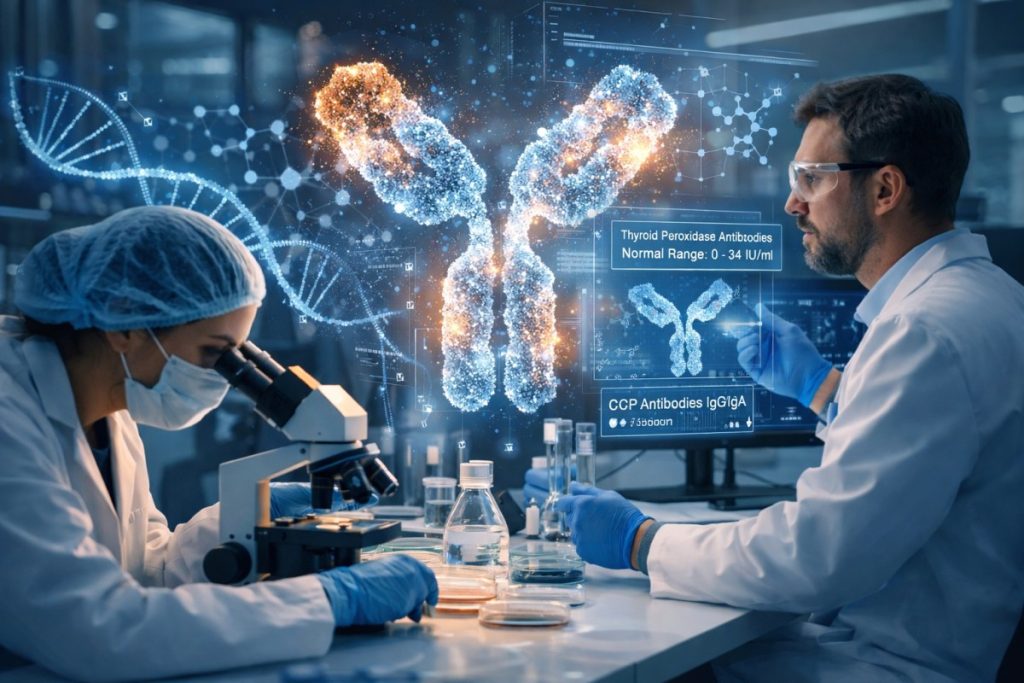
Their power comes from precision. Each antibody targets a specific molecular structure, allowing doctors to treat disease while minimizing damage to healthy tissue. This specificity explains why antibody-based therapies dominate treatments for cancer, autoimmune disorders, inflammatory diseases, and rare conditions. Modern AI approaches now allow scientists to target immune molecules like CCP antibodies IgG/IgA, which are crucial in autoimmune research, and accelerate their design digitally.
Today, many of the world’s highest-revenue drugs rely on antibody technology. Yet for decades, discovering these powerful molecules remained inefficient.
AI-Designed Antibodies: The Limits of Traditional Antibody Discovery
Historically, scientists discovered antibodies by immunizing animals and screening massive numbers of candidates. Researchers exposed mice or other animals to a disease target, then searched for antibodies that appeared to bind effectively.
This process created several challenges:
-
It consumed years of research time
-
It required extensive lab infrastructure
-
It depended heavily on biological chance
-
It produced high failure rates late in development
Even promising candidates often failed due to instability, manufacturing issues, or unexpected immune reactions. As a result, drug discovery remained expensive, slow, and unpredictable.
Biology led the process. Scientists reacted. That dynamic has now reversed.
AI-Designed Antibodies: How AI Is Rewriting Drug Discovery
By 2026, AI has transformed antibody discovery into a design-driven discipline. Instead of waiting for nature to generate useful molecules, researchers define a disease target first and ask AI systems to design an antibody that fits it precisely.
This approach treats biology as an engineering problem.
At the core of this transformation are protein language models and generative diffusion systems, trained on vast datasets of protein sequences, structures, and experimental outcomes. These models learn the rules that govern how proteins fold, bind, and function.
As a result, scientists can now create antibodies from scratch rather than modifying existing ones, accelerating discovery of therapeutics for diseases where rapid intervention is critical, including emerging infections noted in rising trends such as syphilis symptoms.
AI-Designed Antibodies: How AI Designs Antibodies From the Ground Up
Defining the Target With Precision
Every design process begins with clarity. Researchers identify a specific disease target, such as a viral protein, cancer marker, or inflammatory molecule. They then provide AI systems with the target’s three-dimensional structure, either experimentally measured or computationally predicted.
This structure defines the exact shape and chemistry the antibody must recognize. In simple terms, researchers analyze the lock before designing the key. Many AI-generated therapies now aim to improve upon or complement established drugs like adalimumab, offering new treatment avenues for patients.
Beyond targeting well-known disease proteins, AI-designed antibodies also explore autoimmune markers, including thyroid-related proteins. Understanding the normal range of thyroid peroxidase antibodies allows scientists to design therapies that can modulate immune responses precisely, potentially improving treatments for thyroid disorders.
Teaching AI the Language of Proteins
Next, AI systems rely on protein language models trained on millions of known proteins and antibodies. These models learn how amino acid sequences behave, how they fold into stable structures, and how small changes affect function.
By 2026, these models no longer just replicate known biology. They generalize it, allowing them to imagine new protein designs that still obey biological constraints. This capability allows design of cutting-edge molecules like Atlas antibodies that can target multiple disease pathways simultaneously.
Generating De Novo Antibodies
Using generative diffusion models, AI begins creating brand-new antibody sequences. The system starts with randomness and iteratively refines each design to improve binding strength, specificity, and stability.
Rather than adjusting antibodies found in nature, the AI builds molecules that have never existed before. This process explains why researchers often say AI can “dream up” antibodies. Digital tools now allow scientists to simulate complex immune targets such as CCP antibodies IgG/IgA, ensuring these new molecules interact as intended before entering the lab.
Testing in Silicon Before the Lab
Before researchers synthesize anything, AI runs extensive virtual tests. These simulations predict how tightly the antibody binds, whether it targets only the intended molecule, how stable it remains under physiological conditions, and the likelihood of unwanted immune reactions. In the lab, scientists often rely on well-characterized platforms and reagents such as BD Biosciences antibodies to validate AI predictions and ensure accuracy in experiments. This combination of digital design and proven lab tools accelerates development while maintaining high reliability.
Designs that fail these tests never leave the computer. This digital filtering saves time, capital, and resources while dramatically improving success rates. In real-world applications, AI-designed antibodies could respond faster to emerging infectious disease trends, including increased focus on conditions like syphilis symptoms.
Rapid Optimization Through Iteration
The strongest candidates then enter rapid optimization loops. AI tweaks sequences to improve performance across multiple dimensions, including binding strength, manufacturability, and shelf stability.
Because these iterations happen digitally, teams can run thousands of design cycles in days. By the time a candidate reaches the lab, it already represents a highly optimized molecule rather than an early-stage guess.
From Lab Validation to Clinical Reality
After digital optimization, researchers synthesize only the top candidates. They test these antibodies in cells and animal models primarily to confirm predictions, not to explore blindly.
By 2026, multiple AI-generated antibody candidates have advanced into preclinical development and early human trials. These programs target cancer, infectious diseases, and rare disorders, building on platforms that include Atlas antibodies and complement therapies like adalimumab.
This milestone confirms that AI-Designed Antibodies have moved beyond theory. They now operate inside real-world drug pipelines.
Why This Changes the Economics of Biotech
This shift reshapes not only science, but also biotech economics.
Traditional drug discovery favors large pharmaceutical companies with long timelines and deep capital reserves. AI-driven antibody design lowers those barriers by:
-
Compressing discovery timelines from years to months
-
Reducing late-stage failure rates
-
Allowing smaller teams to compete
-
Improving capital efficiency
Drug discovery now resembles software-driven engineering rather than biological exploration. For startups, this creates speed. For investors, it introduces predictability. Rising interest in therapies like adalimumab alternatives and AI-driven antibody platforms highlights emerging market opportunities.
AI-Designed Antibodies: Investing in the Rise of AI-Driven Antibodies
As AI-designed biologics move closer to commercialization, investors increasingly view this space as a distinct category within biotech.
Large Pharma Embracing AI
Major pharmaceutical companies such as Roche, Pfizer, AstraZeneca, and Merck actively integrate AI into their antibody discovery pipelines. These firms combine AI-powered design with regulatory expertise, clinical infrastructure, and manufacturing scale.
As AI-designed candidates progress through trials, these incumbents gain a strong advantage in bringing them to market, especially when complementing blockbuster therapies like adalimumab.
AI-Native Biotech Platforms
Another opportunity lies in AI-first biotech companies that build antibody design platforms rather than single-drug bets. These firms generate multiple candidates and monetize through partnerships, licensing, and co-development agreements.
Investors often focus on companies that demonstrate:
-
Multiple AI-generated candidates
-
Repeatable partnership revenue
-
Clear evidence of reduced development timelines
The inclusion of platforms capable of producing Atlas antibodies gives these companies a competitive edge in both autoimmune and infectious disease markets.
Infrastructure and Compute Enablers
AI-driven antibody discovery requires enormous computational power. This demand benefits companies providing cloud infrastructure, AI accelerators, and high-performance computing systems.
As biotech R&D increasingly resembles large-scale AI workloads, infrastructure providers gain indirect exposure to this transformation.
AI-Designed Antibodies: The Future of Biotech
Looking ahead, AI-designed antibodies could expand into personalized medicine, preventive therapies, and rapid-response treatments for emerging diseases. Researchers already explore ways to tailor antibodies to individual patients and rapidly generate therapies for new pathogens.
As regulatory confidence grows and clinical data accumulates, AI-designed antibodies may become the default starting point for biologics discovery, complementing established therapies like adalimumab, and innovative platforms like Atlas antibodies. Even broader health trends, such as rising awareness of thyroid peroxidase antibodies normal range and syphilis symptoms, underscore the market potential for rapid antibody development.
Final Takeaway
In 2026, AI no longer plays a supporting role in drug discovery. It acts as the architect.
Antibodies, once products of biological chance, now emerge through intentional design. AI-Designed Antibodies mark the beginning of a new era—one where medicine becomes programmable, scalable, and precise.
Drug discovery has entered its intentional age, offering both scientific breakthroughs and compelling opportunities for investors and innovators alike.