
 Written by
 AI Does Not Run on Code — It Runs on Copper, Sunlight, and Power
In 2026, the market has accepted a simple but profound truth: AI does not run on code; it runs on copper, sunlight, nuclear energy, and reliable infrastructure.
The story began in 2024, when Large Language Models (LLMs) promised to automate nearly every human task. By 2025, the focus shifted to the “Inference Era,” emphasizing efficiency, deployment, and compute optimization. Today, the narrative has moved decisively into the physical realm. AI is no longer primarily a software story—it is an industrial story.
A single AI query now consumes roughly ten times more electricity than a Google search. Hyperscale AI data centers are reaching 1-gigawatt (GW) footprints, equivalent to a small nuclear reactor. The bottleneck is no longer computational speed; the critical limiting factor is whether grids and energy systems can deliver continuous, high-density power.
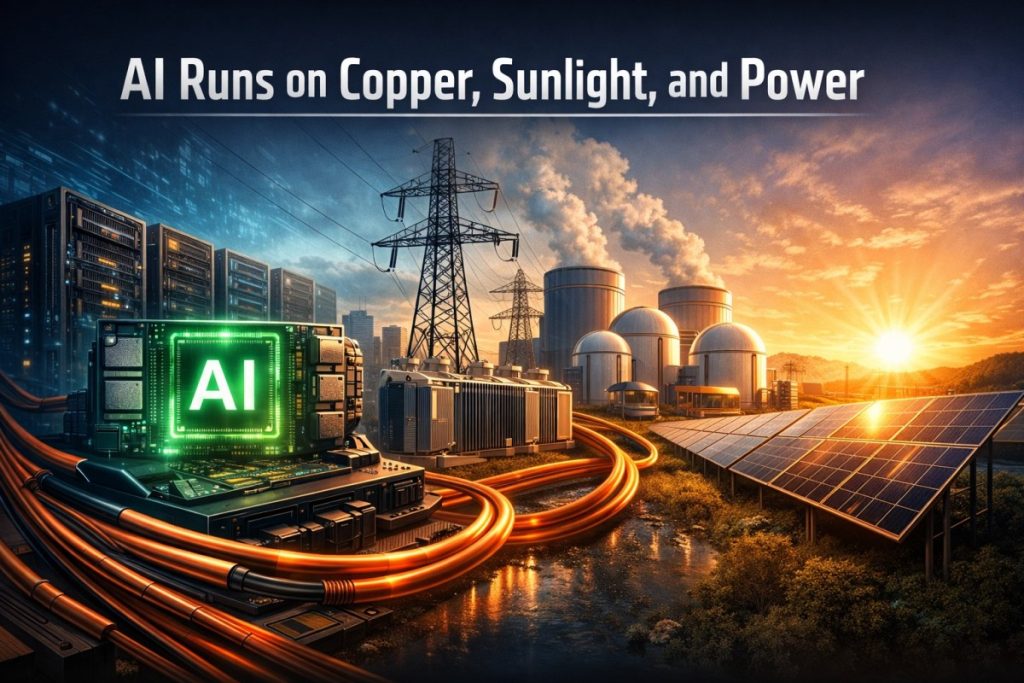
Eaton Corp ($ETN): The “AI Blood” Hardware
If Nvidia provides the brains of AI, Eaton supplies the blood.
Eaton has become essential to modern data centers by controlling the grid-to-chip power pathway. GPUs and AI accelerators cannot operate without transformers, switchgear, circuit breakers, and power distribution units. Eaton manufactures this equipment at scale, enabling hyperscale facilities to plug safely into high-voltage transmission networks.
The surge in AI deployment has created a structural bottleneck. Eaton’s backlog has expanded over 34% since 2024, as every hyperscaler and AI lab competes for limited electrical equipment. Investors recognize that companies supplying transformers and breakers enjoy near-guaranteed revenue in a market constrained by supply.
Eaton’s valuation reflects this new reality. Once a conservative dividend stock, it now trades at price-to-earnings multiples typical of high-growth software companies, signaling that AI cannot scale without reliable power delivery.
First Solar ($FSLR): The “Sunlight” Supply
If Eaton represents blood, First Solar represents fuel.
In 2026, powering AI hubs with renewable energy is no longer optional. Amazon, Microsoft, and Google have all committed to 100% renewable or carbon-free energy, effectively restricting coal and natural gas for new hyperscale campuses.
First Solar entered 2026 with a backlog exceeding 50 gigawatts, locking production through 2029. Investors now view solar as critical AI fuel infrastructure, not just a green-subsidy play. Its thin-film technology provides durability, long-term efficiency, and suitability for large-scale deployments near data centers.
The company’s American-made supply chain adds strategic value in a fragmented global trade environment. Energy security is now as important as cost, making First Solar a linchpin for AI expansion.
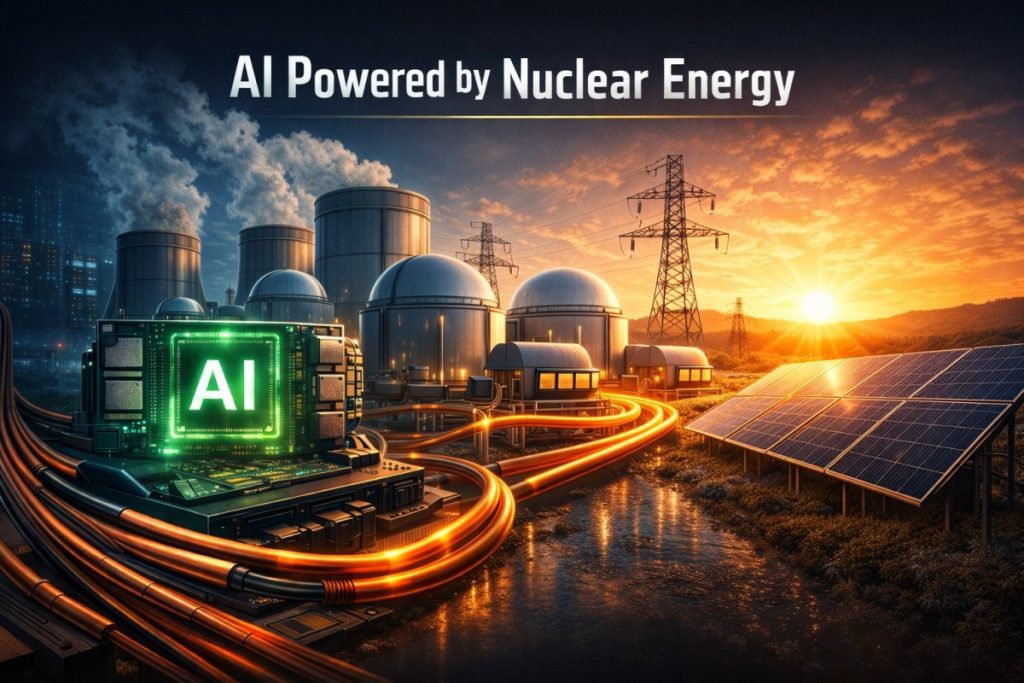
Nuclear Energy: SMRs and Big Tech Investment
While solar and transformers address part of the energy equation, hyperscale AI cannot rely solely on intermittent power. Data centers require 24/7 baseload energy, and nuclear has reemerged as a critical solution.
Small Modular Reactors (SMRs) from NuScale ($SMR) and Oklo ($OKLO) now play a strategic role. SMRs deploy faster than traditional reactors, scale modularly, and can colocate near AI campuses, providing reliable, predictable power.
Big Tech has embraced nuclear energy as a strategic enabler. Microsoft explicitly integrates nuclear power into its data center operations to ensure carbon-free, continuous electricity. Amazon, through AWS, explores SMRs for isolated AI campuses, bypassing stressed regional grids. Nuclear energy now represents both energy security and operational reliability, essential for scaling AI workloads.
Copper: The Veins of AI
Infrastructure challenges extend underground. If electricity is the blood of AI, copper is the veins.
Analysts project a refined copper deficit exceeding 330,000 tons in 2026, largely driven by AI deployment. Traditional data centers consume roughly 5,000 tons, while hyperscale AI facilities can require up to 50,000 tons, including wiring, transformers, and redundant systems.
Copper prices have surged toward $12,000–$15,000 per ton, prompting investors to rotate from precious metals into base metals. Copper now functions as the digital energy currency of the AI era, with mining companies enjoying structurally higher demand.
Cooling and Water: The Hidden Constraints
Electricity enables AI, but cooling sustains it.
AI workloads generate immense heat. Dense GPU clusters cannot rely on air cooling alone. Hyperscalers implement liquid cooling, immersion cooling, and advanced heat-exchange technologies, which consume vast amounts of water.
A single hyperscale AI campus can require millions of gallons of water per day to maintain safe operating temperatures. Regions with sufficient power can still restrict AI deployments due to water scarcity or environmental regulations, creating a second hard constraint after electricity.
Industrial cooling and water infrastructure companies now occupy a critical role in the AI ecosystem, proving that thermal management is as important as compute or power.
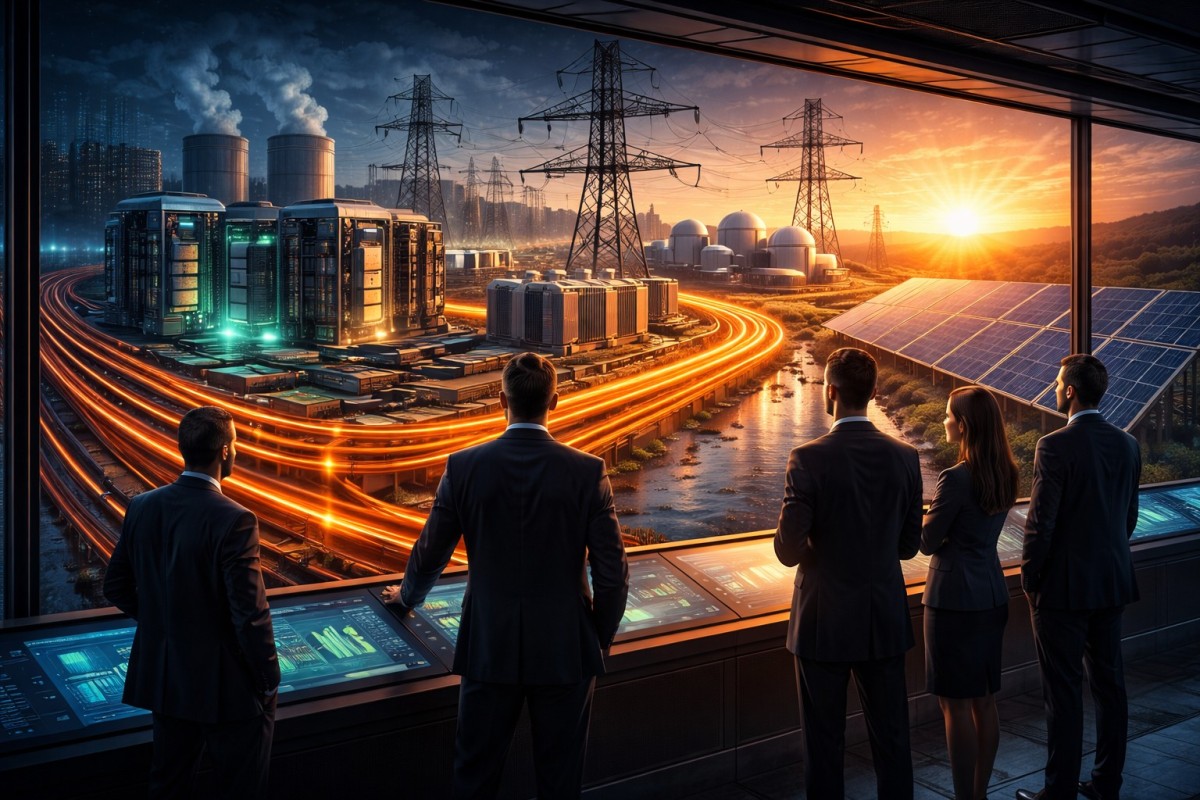
Grid Congestion and Permission Economics
Even when power exists, companies cannot always access it.
Grid congestion and regulatory bottlenecks have emerged as major barriers. Hyperscale data centers routinely wait three to seven years for transmission network connections. Utilities face capacity limits, regulators proceed cautiously, and local communities often resist rapid infrastructure expansion.
This has created permission economics, where AI growth depends on regulatory approvals and infrastructure timelines rather than technical capability. Companies with experience navigating permitting and long-cycle infrastructure projects gain a decisive advantage. The market rewards those embedded in grid and regulatory networks over purely software-focused players.
The Backbone of AI: Compute Hardware
While industrial infrastructure provides power, cooling, and metals, the backbone of AI is compute hardware. Without GPUs, CPUs, memory, and networking chips, all the energy from solar, nuclear, and the grid would go unused.
Key companies powering AI compute include:
-
Nvidia ($NVDA): Dominates GPUs for training and inference, powering the largest AI clusters worldwide.
-
AMD ($AMD): Provides AI GPUs and CPUs for hyperscale cloud deployments.
-
Intel ($INTC): Offers AI accelerators, CPUs, and FPGA solutions for inference workloads.
-
Broadcom ($AVGO): Supplies networking, storage, and interconnect silicon for high-throughput AI data movement.
-
Marvell ($MRVL): Produces data center networking and storage controllers, enabling GPUs and CPUs to communicate efficiently.
-
Micron ($MU): Delivers high-bandwidth memory crucial for large AI models.
These companies form the brains and connective tissue of the AI industrial ecosystem. While Eaton, First Solar, SMRs, and cooling infrastructure deliver blood and fuel, the compute layer executes the AI workloads. Without both layers, hyperscale AI cannot function.
Market Pivot: From Software to Infrastructure
The capital rotation in 2026 is clear: investors are moving from speculative AI software to the physical enablers of AI growth.
-
2024: Focus on LLMs, Nvidia, and cloud computing—the “brain trade.”
-
2026: Focus on Eaton, First Solar, nuclear SMRs, copper miners, Vertiv, and cooling providers—the “blood and fuel trade.”
Software hype alone no longer drives returns. Investors now reward companies providing physical infrastructure, reliable energy, and critical materials, creating structurally resilient growth opportunities.
The Age of Industrial AI
The 2026 AI ecosystem demonstrates a crucial lesson: AI cannot scale on code alone. It scales on physical resources—transformers, solar panels, nuclear reactors, copper, water, cooling systems—and compute hardware that forms the backbone of every workload.
The winners of this era will not be the companies with the smartest chatbots or largest models. They will be those who control:
-
Power delivery (Eaton, Quanta, GE Vernova)
-
Renewable and baseload energy (First Solar, SMRs, Constellation Energy)
-
Cooling and thermal management (Vertiv, EMCOR, Sterling)
-
Critical metals (copper miners)
-
Compute hardware backbone (Nvidia, AMD, Intel, Broadcom, Marvell, Micron)
In the new hierarchy, blood, fuel, cooling, metals, and compute backbone matter more than algorithms alone. AI’s future depends as much on industrial logistics and hardware supply as it does on software, and investors who understand this industrial ecosystem stand to capture the next wave of AI growth.