
 Written by
 Canada’s AI Power Play: Brookfield, NVIDIA, and the $100B Infrastructure Launch
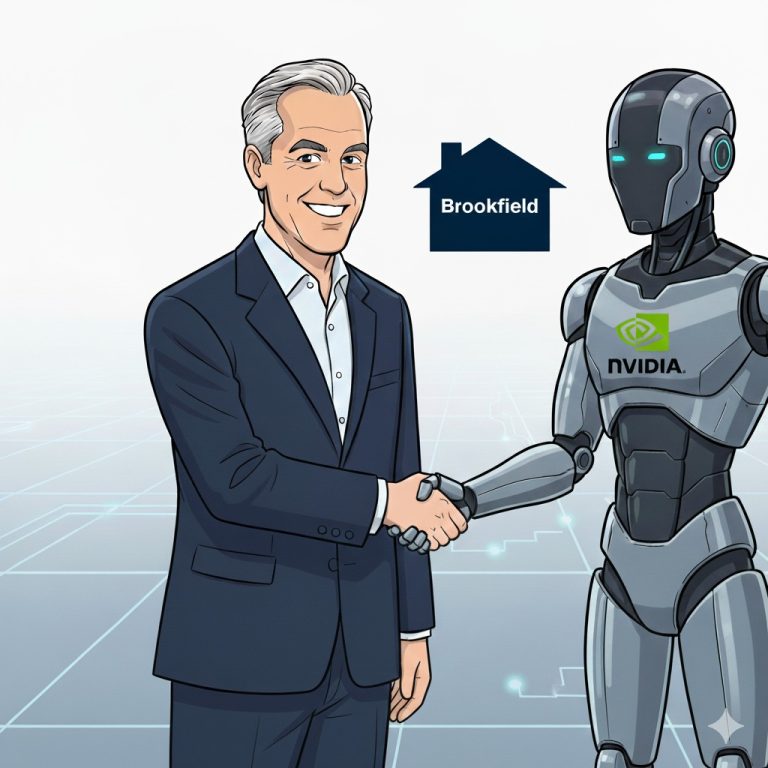
As of March 2026, the global race for AI sovereignty has transitioned from a theoretical gold rush into a physical industrial revolution. Brookfield Asset Management, the Canadian-born global infrastructure titan, has officially moved its ambitious AI roadmap into full-scale activation. By partnering with NVIDIA and the Kuwait Investment Authority (KIA), Brookfield is no longer just a real estate play—it has become the primary architect of the “AI utility” model, a vertical integration of power, land, and compute that is reshaping the global economy.
The $100 Billion BAIIF Activation
The Brookfield Artificial Intelligence Infrastructure Fund (BAIIF) has officially surpassed its initial milestones. Launched in late 2025 with a target of $10 billion in equity, the fund has successfully leveraged co-investments to mobilize up to $100 billion in total asset value. In a landmark achievement for Canadian finance, Brookfield has effectively “crowded in” institutional capital to solve the single greatest bottleneck in technology: the physical space and energy required to run high-density AI models.
Unlike traditional data center funds that merely act as landlords, BAIIF operates across the entire value chain. By controlling the “full stack”—from the lithium mines and hydroelectric dams to the liquid-cooled server racks—Brookfield is insulating itself from the supply chain volatility that plagued the industry in 2024 and 2025.
Launch of Radiant: The World’s First Integrated AI Utility
In February 2026, Brookfield reached a critical turning point with the launch of Radiant, a new portfolio company created through the merger of its internal AI assets and the UK-based Ori Industries. Radiant serves as the first vertically integrated “AI Factory” operator.
As a premier NVIDIA Cloud Partner, Radiant provides full-stack AI services, including GPU-as-a-Service and sovereign cloud solutions for governments and large enterprises. By utilizing Brookfield’s proprietary land and power, Radiant can offer compute at a lower cost-basis than traditional hyperscalers. This “utility-grade” pricing is specifically designed to attract sovereign governments looking to build domestic AI capabilities without relying on the US-based “Big Tech” clouds.
Vera Rubin DSX: From Roadmap to Reality
The technical heart of this partnership shifted into high gear on March 16, 2026, when NVIDIA announced the general availability of the Vera Rubin DSX reference design. This is the architecture Brookfield is using to build its next generation of “AI Factories.”
The Vera Rubin platform is optimized for the “Agentic AI” era—where AI models don’t just answer questions but execute complex tasks autonomously. The DSX Max-Q configuration allows Brookfield to deploy 30% more infrastructure within existing power constraints by dynamically provisioning energy across the entire factory. This technological leap ensures that Brookfield’s facilities are not just larger, but significantly more efficient than those built even 12 months ago.
Solving the Power Gap with Bloom Energy
The primary risk to AI scaling in 2026 remains the “Power Latency” crisis—the inability of the aging electrical grid to keep pace with GPU demand. To solve this, Brookfield’s $5 billion framework agreement with Bloom Energy has moved from planning to installation.
By deploying Bloom’s fuel cell technology, Brookfield is building “behind-the-meter” power plants that bypass the electrical grid entirely. These solid-oxide fuel cells provide clean, resilient energy directly to the AI factories. Crucially, as of 2025, Bloom’s servers became 800V DC-ready, allowing them to plug directly into NVIDIA GPU racks. This eliminates the energy losses associated with traditional AC-to-DC conversion, saving millions in operational costs annually and providing a massive competitive moat for Brookfield.
Mark Carney’s Vision of Sustainable Intelligence
Mark Carney, Vice-Chair of Brookfield, remains the intellectual architect behind the fund’s sustainability mandates. In Brookfield’s 2026 Investment Outlook, Carney emphasized that “disciplined transformation” is the theme of the year.
By pairing AI growth with carbon-neutral power solutions, Carney is positioning Brookfield as the global leader in “Green AI.” This strategy is timely; as governments in Europe and North America implement stricter carbon-accounting laws for data centers, Brookfield’s pre-existing clean-power portfolio—one of the largest in the world—serves as a massive de-risking mechanism for institutional investors.
Canada’s Strategic Security: The Saab and Cohere Alliance
The “Massive AI Shift” isn’t limited to infrastructure; it has reached the highest levels of Canadian national defense. In March 2026, Swedish defense firm Saab formalized a partnership with the Canadian AI powerhouse Cohere.
This agreement integrates Cohere’s specialized Large Language Models (LLMs) into Saab’s GlobalEye airborne surveillance system. By utilizing Canadian-made Bombardier Global jets as the platform, the deal creates a sovereign defense capability where data processing happens on-site and under domestic control. This dovetails perfectly with Brookfield’s infrastructure mission: the compute power generated in Brookfield’s AI factories will eventually support the secure, on-premises data processing required for Canada’s next-generation surveillance and defense systems.
The Convergence: Compute, Energy, and Sovereignty
The threads of this story—Brookfield’s $100 billion activation, NVIDIA’s Vera Rubin rollout, and Canada’s growing sovereign defense ambitions—illustrate a powerful convergence. We are moving past the era of “digital-only” AI and into the era of “Physical AI.”
For investors and the readers of WebKarobar, the takeaway is clear: the winners of 2026 are the companies that own the “atoms” as well as the “bits.” Brookfield’s ability to deploy capital at this scale, paired with NVIDIA’s relentless silicon innovation, has created a blueprint for how national economies will function in the decade ahead. This isn’t just an investment in real estate; it is the construction of a new global power grid, optimized for intelligence.