
 Written by
 How China is Leading the AI-Powered Network Boom
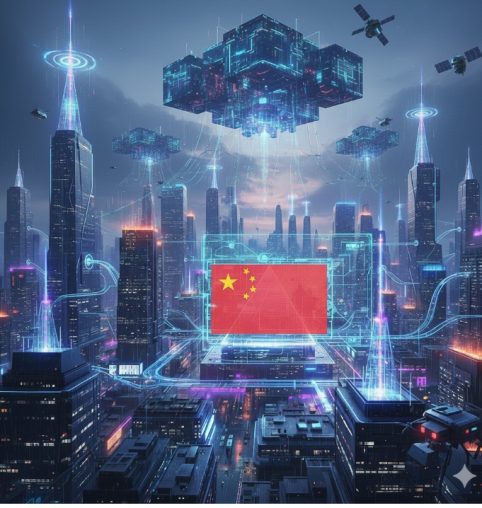
The global telecom industry is undergoing a massive shift, and China is one of the biggest drivers behind it. Amid this transformation, the next generation of infrastructure—far beyond 5G—builds on a new idea : AI-native networks. This means networks where artificial intelligence is not an extra feature, but the core of how the entire system operates.

The Rise of AI-Native Networks
Traditionally, telecom networks relied on fixed hardware and manual control. Engineers configured towers, optimized traffic, adjusted bandwidth, and handled outages directly. However, as networks expanded—5G, fiber, billions of devices—manual operations became impractical. Consequently, this challenge led to the fusion of AI, cloud computing, and telecom infrastructure into a single intelligent system. In practice, AI-native networks allow AI to manage, optimize, and repair the network automatically. Rather than waiting for engineers to troubleshoot issues, AI predicts failures before they occur. Instead of static bandwidth allocation, it dynamically adjusts speeds based on real-time demand. Moreover, by unifying cloud and telecom systems, the entire network operates seamlessly under AI-driven control. AI models analyze huge amounts of data from towers, routers, devices, and data centers, thereby enabling real-time decisions: routing traffic, reducing latency, increasing capacity, or shifting workloads to the cloud instantly.
Cloud and Telecom Convergence in China
The old telecom architecture separated “the network” from “the cloud.” Now, they are merging. Telecom companies are embedding massive cloud infrastructure directly inside the network, which allows edge computing, processing data closer to users, ultra-low latency essential for robotics, autonomous systems, and VR, and real-time AI services like translation, vision, decision-making, and automation. China’s big players—China Telecom, China Mobile, Huawei—are building “computing power networks” where cloud servers, telecom hardware, and AI processing are tightly integrated.
Global AI-Native Network Race: NVIDIA vs. Huawei
The AI-native network space is heating up as U.S. and European firms push innovations alongside China’s Huawei. NVIDIA and Nokia recently announced a $1 billion partnership to develop AI-powered 5G‑Advanced and 6G infrastructure (AI‑RAN), thus signaling a major push into intelligent networks. Meanwhile, DeepSig demonstrated an AI-native air interface at MWC 2025, showcasing real-time channel adaptation and AI-driven modulation for next-gen wireless. On the China side, China Telecom and Huawei unveiled “5G‑A Intelligent Ultra Pooling Uplink,” integrating AI, 5G‑Advanced, and dynamic resource allocation to support mobile AI services, V2X, edge AI, and real-time applications. As a result, this global competition is driving rapid adoption of AI-native networks, smarter telecom systems, and high-performance computing solutions worldwide.
China’s Tech Surge — with Huawei in the Spotlight
A tangible example of this convergence is the Huawei Pura 80 Ultra, currently trending for its advanced camera system, 5G/5.5G connectivity, and AI-enhanced software. Beyond being a consumer device, it acts as an endpoint in China’s intelligent ecosystem, enabling cloud-powered photography, smart home integration, and AI-driven services. In particular, devices like this serve as practical endpoints in China’s intelligent ecosystem and showcase how Huawei drives modern AI-native infrastructure.
AI-native networks unlock new industries. Autonomous vehicles run on instant cloud intelligence. Smart factories use AI-controlled robots. Remote surgery becomes possible using ultra-stable low-latency networks. City-wide energy optimization improves efficiency. Real-time language translation and assistant services are built directly into devices. Networks are no longer passive channels—they are intelligent platforms. Looking ahead,
the world is moving toward 6G, and AI-native networks are the foundation. China aims to lead this shift, building infrastructure where AI, telecom, and cloud computing function as one unified brain. Ultimately, this convergence is not just an upgrade—it’s the blueprint for the future digital economy.