
 Written by
 Why AI Agent Workflows Are the Future of One‑Person Companies
In the near future, we will see solopreneurs running entire companies alone, powered by AI agents instead of hiring large development teams. Through advanced AI agent workflows, what once required multiple specialists—building products, managing databases, ensuring security, and coordinating operations—can now be handled by one person orchestrating intelligent subagents. These workflows allow tasks to run in parallel, communicate seamlessly, and execute with precision. Tools like Claude Opus 4.6 are already turning this vision into reality, enabling freelancers and developers to deliver complex projects faster, more efficiently, and at a scale previously reserved for full teams.
Orchestration: How AI Teams Work Together
To understand how a single person can manage large-scale projects, you first need to understand orchestration.
Think of a busy restaurant. Chefs cook, sous-chefs prepare ingredients, waiters serve customers, and dishwashers keep everything clean. Each person has a defined role. Without coordination, the kitchen falls into chaos—orders get delayed, dishes are mixed up, and customers leave unhappy. However, when a manager directs the timing and responsibilities of each team member, the restaurant operates smoothly and efficiently.
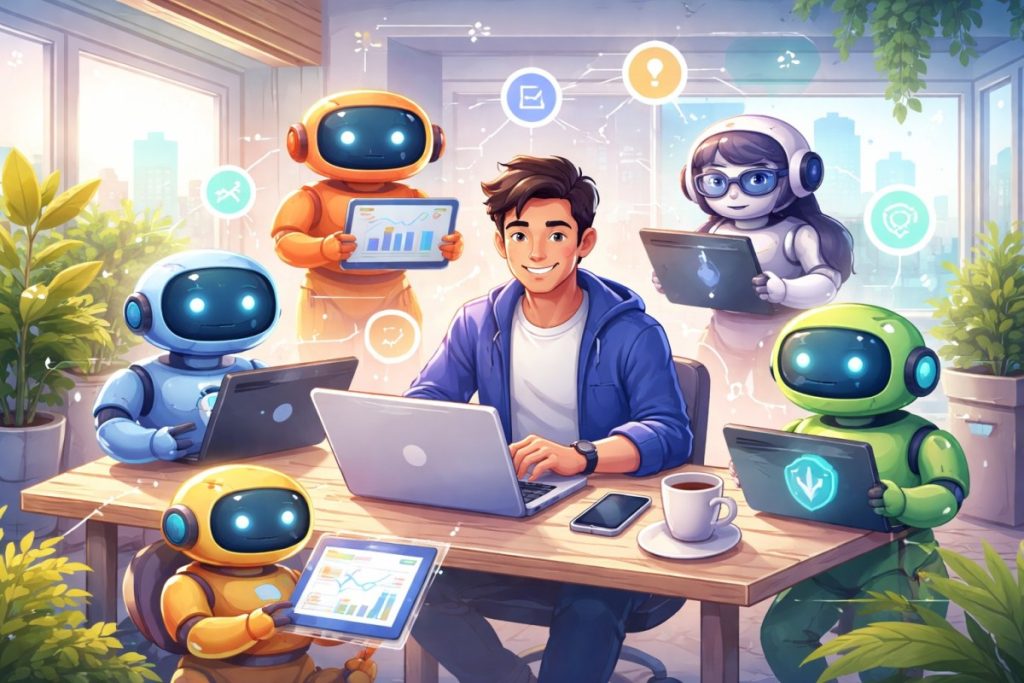
AI agent workflows function in the same way. The solopreneur becomes the manager, while AI subagents take on specialized roles such as writing code, designing interfaces, testing features, or managing databases. Instead of working randomly, these agents follow a coordinated workflow, communicate when necessary, and execute tasks in parallel. Through orchestration, one person can oversee an entire AI-powered “team,” completing complex projects with minimal manual effort. As a result, solopreneurs can now handle work that traditionally required full development departments.
Developers Orchestrating AI Teams
Developers are leading the adoption of AI agent workflows for complex technical projects. Using tools like Claude Opus 4.6, they can deploy multiple AI subagents simultaneously, each responsible for a specific component of a project.
-
Isolate context: Each subagent maintains its own temporary memory, preventing confusion in the main workflow.
-
Parallel tasking: One agent writes API code while another analyzes databases and a third runs automated tests.
-
Specialize tasks: Subagents operate with restricted tools to stay focused and safe.
The Agent Teams feature allows subagents to communicate directly, resolving dependencies without requiring constant human oversight. A database agent can notify the API agent of schema changes in real time. Developers monitor these agents live, intervening only when necessary. This setup reduces errors, accelerates production, and allows small teams to manage enterprise-level projects efficiently.
Freelancers as One-Person Agencies
Freelancers are at the forefront of the solopreneur revolution. Using Opus 4.6, a single freelancer can act like an entire agency:
-
Spawn multiple subagents: One handles frontend design, another manages APIs, and a third oversees databases—all at the same time.
-
Define expert personas: Freelancers create subagents for specialized roles, such as DevOps engineers or security auditors.
-
Enable peer-to-peer coordination: Subagents communicate with each other to resolve dependencies and avoid bottlenecks.
Freelancers store client-specific rules and workflow guidelines in CLAUDE.md files. They can also deploy “Devil’s Advocate” subagents to challenge design decisions and catch edge cases before client delivery. Adaptive effort levels allow freelancers to manage costs, giving subagents minimal resources for simple tasks and full resources for complex operations.
Thanks to this system, a single person can deliver multi-component, high-value projects that once required entire development teams. This capability allows solopreneurs to scale their output dramatically without hiring additional staff.
Common Projects and Use Cases
Solopreneurs and developers apply these AI-driven workflows to a variety of projects:
-
SaaS MVPs: Complete products built with frontend, backend, and database modules working in parallel.
-
Enterprise automation: Complex spreadsheets, documents, and internal workflows handled autonomously.
-
Client deliverables: Websites, apps, or prototypes delivered faster and with fewer errors.
-
Large-scale coding tasks: Debugging, testing, and refactoring substantial codebases efficiently.
Freelancers often focus on client-specific projects, while developers orchestrate multi-month enterprise projects with dozens of subagents collaborating in parallel.
Choosing the Right Model: Opus vs Sonnet
Claude offers multiple AI models, each suited for different needs:
| Model | Best For | Strengths | Cost (Approx.) |
|---|---|---|---|
| Opus 4.6 | High-value, complex workflows | Deep reasoning, multi-agent orchestration, long-context tasks | $5–$37 per million tokens |
| Sonnet 4.6 | General automation, affordable workflows | Speed, cost-efficiency, near-Opus performance | $3–$15 per million tokens |
Many solopreneurs combine models strategically: they use Sonnet for daily tasks and Opus for high-stakes projects where precision and reasoning matter most. This combination allows them to balance efficiency and cost effectively.
The Future of Freelance AI
The rise of orchestration, subagents, and Agent Teams is reshaping productivity and business models:
-
A single freelancer can now deliver agency-level results.
-
Specialized agents reduce human errors and speed up project delivery.
-
Startups and solopreneurs can scale operations without hiring large teams.
The ecosystem is expanding rapidly. Tools like OpenClaw are emerging to enhance automation and workflow orchestration across multiple AI models, making it easier for solopreneurs to coordinate agents, streamline tasks, and integrate new capabilities. As more AI tools enter the market, solopreneurs will have an ever-growing arsenal to run businesses efficiently, delivering high-quality results faster than ever before.
One-Person AI-Powered Agencies Are Here
AI-powered orchestration is no longer a futuristic concept—it’s a practical strategy for modern business. Solopreneurs leveraging Claude Opus 4.6, Agent Teams, and emerging tools like OpenClaw can operate entire companies alone, producing complex projects with speed, accuracy, and creativity. Freelancers use subagents to handle coding, design, QA, and workflow automation, achieving agency-level output without extra staff.
🛠️ The 2026 Solopreneur “Agent Stack” is redefining how solo founders work:
-
Virtual Operations: Tools like Lindy manage inboxes, qualify leads, and update CRMs automatically.
-
Custom Agent Builders: Platforms such as Relevance AI and Flowise AI allow founders to create their own AI workforce, automating complex, branching business logic without coding.
-
Autonomous Engineering: Devin AI can plan, code, debug, and deploy software projects independently, enabling non-technical founders to launch full SaaS products.
-
Collaborative Teams: Frameworks like CrewAI let “crews” of agents debate and collaborate—researchers, writers, and reviewers producing high-quality output together.
🚀 Today’s agents handle lead generation, customer support triage, autonomous commerce, and Answer Engine Optimization (AEO), letting solopreneurs scale faster. Early adopters report up to 80% reduction in administrative workload and 35% lower operational costs compared to 2025.
The ultimate ambition? The One-Person Unicorn—a billion-dollar company run by a single human orchestrating a massive swarm of AI agents. With OpenClaw, Klover.ai, and other agentic platforms emerging, this vision is no longer science fiction—it’s the AI solopreneur revolution in action.