
 Written by
 Michael Burry’s Latest Bet Is Trending: The $1.1 Billion AI Short
Michael Burry’s bet against the artificial intelligence sector has become the primary talking point for investors in early 2026. As of January 17, the legendary “Big Short” investor has placed a massive $1.1 billion notional wager using put options against industry leaders Nvidia and Palantir, while recently revealing a new bearish position against Oracle. Burry isn’t simply saying AI is a fad; he is arguing that the companies building the infrastructure are caught in a financial “trap” that will eventually destroy their profit margins. By targeting these high-flying stocks, Michael Burry’s bet signals deep skepticism toward current market valuations and the aggressive accounting methods used by tech giants to hide the true cost of AI hardware.

Michael Burry’s Bet: Betting Against Palantir and Nvidia
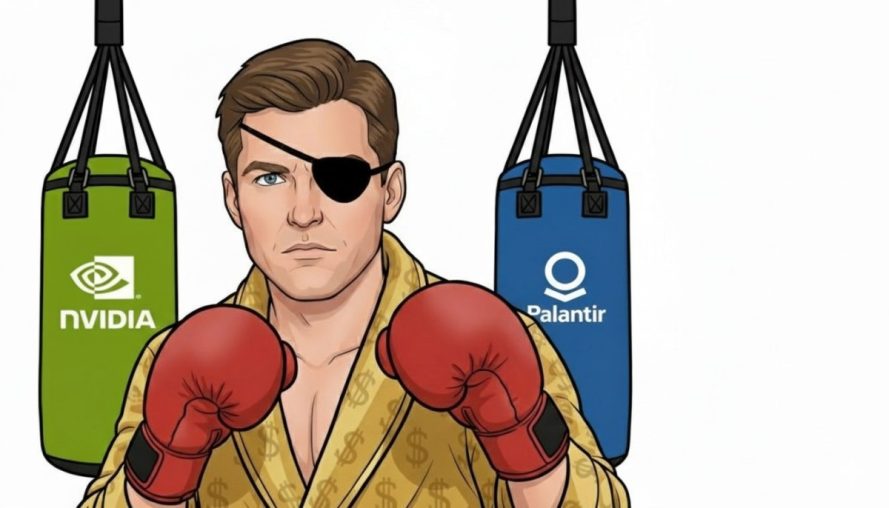
The core of Michael Burry’s bet lies in his massive positions against the two most popular names in the AI rally. According to recent regulatory filings, Burry’s firm, Scion Asset Management, holds $912 million in put options against Palantir (PLTR) and $187 million in put options against Nvidia (NVDA). These “put options” act like insurance policies that gain value if the stock prices fall. Burry believes these companies have reached “astronomical” price-to-earnings multiples that the real economy cannot support, especially as the initial rush to buy AI chips begins to slow down.
Michael Burry’s Bet: Other Big Names Are Taking Notice
While the news of Michael Burry’s bet is trending, he is far from the only “smart money” player exiting the sector. In January 2026, Peter Thiel—a co-founder of Palantir—reportedly sold his entire $100 million stake in Nvidia, mirroring Burry’s concerns about a potential bubble. Additionally, SoftBank has been liquidating various tech holdings to raise cash for its own private energy projects, suggesting that the insiders who built the AI industry are now looking for the exit. When major investors move at the same time as Michael Burry’s bet, it shows a big change in the market. It means the experts are no longer just following the AI hype. Instead, they are shifting their focus toward protecting their money and keeping it safe.
The “Escalator Theory”: Why AI Spending is a Trap
The most technical part of Michael Burry’s bet involves an alleged “accounting fraud” regarding hardware depreciation. As tech giants purchase billions in Nvidia’s latest chips, they must account for how quickly that hardware loses value. Burry points out that while the AI hardware product cycle is incredibly fast—with chips often becoming obsolete in 2 to 3 years—many “hyperscalers” like Meta and Microsoft are depreciating this equipment over 5 to 6 years. Burry argues that by pretending the hardware lasts longer than it actually does, these companies are hiding the true cost of AI. He estimates this “mirage” could be inflating global tech profits by as much as $176 billion between 2026 and 2028.
Michael Burry’s Bet: The $176 Billion “Depreciation Mirage”
The most technical and alarming part of Burry’s 2026 thesis involves an alleged “accounting fraud” regarding hardware depreciation. As tech giants purchase billions of dollars in Nvidia’s latest “Vera Rubin” chips, they must account for how quickly that hardware loses value.
Burry points out that while the AI hardware product cycle is incredibly fast—with chips often becoming obsolete in 2 to 3 years—many “hyperscalers” like Meta, Google, and Microsoft are depreciating this equipment over 5 to 6 years.
“Understating depreciation by extending the useful life of assets artificially boosts earnings—one of the more common frauds of the modern era,” Burry recently wrote.
According to Burry’s research, this sleight of hand could be inflating global tech profits by as much as $176 billion between 2026 and 2028. He specifically singled out Oracle and Meta, estimating that by 2028, Oracle could be overstating its earnings by 26.9% and Meta by 20.8%. If Burry is right, the “record profits” currently being reported are an accounting mirage that will vanish when the hardware must be replaced much sooner than the books suggest.
Silicon Valley Giants Are Taking Notice: The Thiel Exit
Burry is no longer a lone voice. In the first weeks of 2026, other Silicon Valley patriarchs began to exit the trade. Most notably, Peter Thiel, the co-founder of Palantir, has reportedly sold his entire Nvidia stake, valued at approximately $100 million.
Thiel, through his fund Thiel Macro, also slashed his Tesla holdings by 76%. His move signals a fundamental lack of confidence in the current valuations, with Thiel privately comparing the AI frenzy to the 1999 dot-com bubble. When the man who co-founded one of the companies Burry is shorting (Palantir) starts selling the chips (Nvidia) that power it, the market takes notice.
Warren Buffett: The Shovel Sellers vs. the Land Owners
Interestingly, while Burry is aggressively shorting the “pure plays,” Warren Buffett has taken a different path. While Buffett has avoided Nvidia and Palantir, he recently increased his stake in Alphabet (Google) to $4.9 billion. This creates a fascinating divide for investors to watch in 2026. Burry is betting against the “shovel sellers”—the hardware and chip makers—believing their market is a “ticking bomb” that will pop once the initial buying spree ends. Conversely, Buffett is betting on the “land owners”—established platforms with diversified ecosystems and massive cash flow. Buffett seems to believe these platforms are “resilient cash machines” that will successfully harvest the long-term value of AI, even if the hardware providers eventually crash.
Lessons from Contrarian Thinking: Timing vs. Truth
For retail investors, Burry’s current strategy is a masterclass in risk management. He isn’t saying that AI is “fake”; he is saying it is too expensive to be profitable for the companies buying the hardware. His move reminds investors to look past the “hype cycle” and focus on the Cash Flow Statement rather than the headline earnings.
The risks for Burry are equally high. As many noted during the 2008 crisis, Burry was “right, but early” for years, nearly losing his firm in the process. Shorting a bubble is a dangerous game because, as the saying goes, “the market can stay irrational longer than you can stay solvent.”
The Bottom Line: A Collision Course
As we move through 2026, the market is on a collision course. On one side are the hyperscalers and AI evangelists who believe we are at the dawn of a new industrial era. On the other side is Michael Burry, armed with a billion-dollar bet and a spreadsheet showing that the “AI Miracle” is being funded by accounting tricks and a desperate “escalator” war.
Whether Burry earns another “Big Short” legacy or suffers a massive loss on his put options will be the defining story of the 2026 market. For now, he has succeeded in one thing: he has made the world’s most confident market stop and look at the footnotes.