
 Written by
 Micron’s Blockbuster Earnings Define a New Memory Era
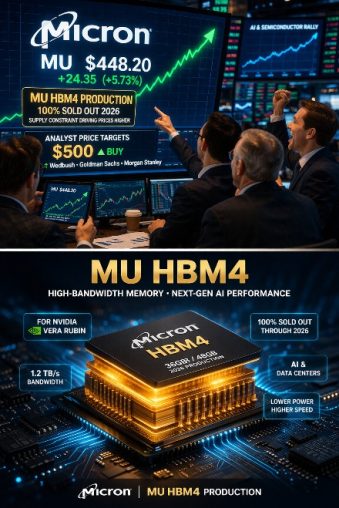
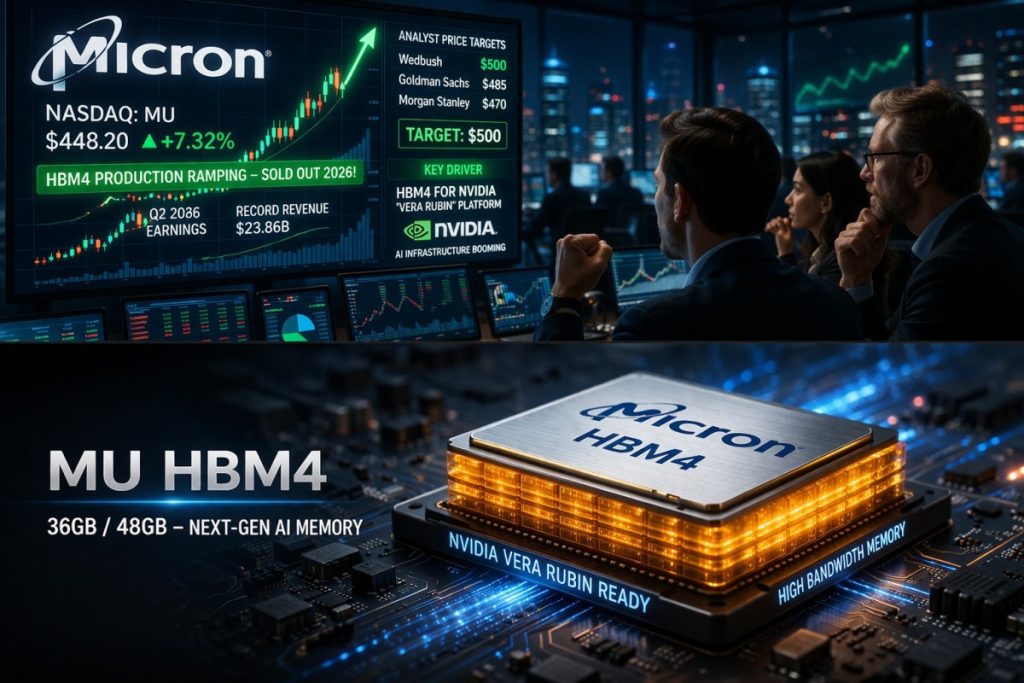
In March 2026, Micron Technology, Inc. (MU) reported record earnings as MU HBM4 Production ramped up to meet the surging demand for AI memory, driving $23.86 billion in revenue and $12.20 in adjusted earnings per share. Investors initially reacted enthusiastically, seeing Micron at the center of the AI infrastructure boom. Even so, the stock experienced short-term volatility, reflecting deeper questions about future supply, capacity expansion, and long-term sustainability.
AI Memory Demand: A Structural Shift, Not Just a Spike
Micron’s performance is driven by a broad, sustained shift in computing. AI workloads now consume massive amounts of data, requiring memory solutions far beyond what traditional DRAM can handle. High-Bandwidth Memory (HBM) has become essential for next-generation AI servers, supporting rapid training and inference for complex AI models.
To address this unprecedented demand, MU HBM4 Production has officially entered high-volume manufacturing, tailored specifically for NVIDIA’s Vera Rubin platform. These HBM4 modules, offered in 36GB and 48GB configurations, allow Micron to serve high-value AI clients while commanding premium pricing. This combination of advanced technology and scarcity has created a structural advantage for Micron in the memory market.
Unlike typical semiconductor cycles, which fluctuate between oversupply and shortage, the current market reflects structural growth in AI infrastructure. Analysts emphasize that this is a long-term trend rather than a temporary spike, fundamentally reshaping how memory is consumed and valued.
Micron’s Strategic Shift: AI Over Consumer Markets
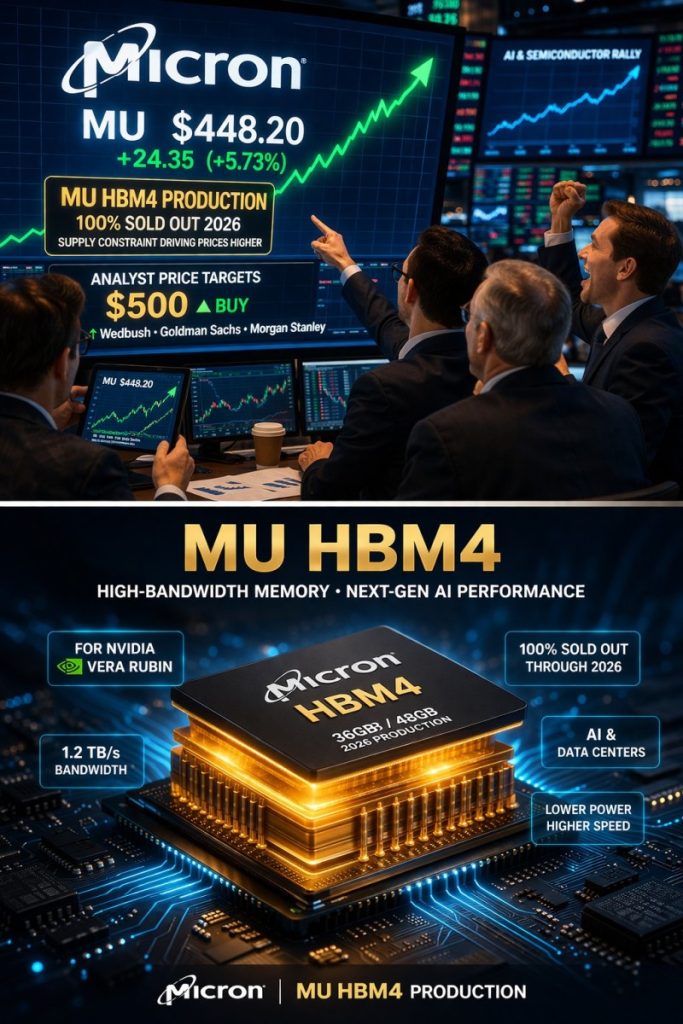
Micron has intentionally refocused its business toward high-margin enterprise and AI applications. In late 2025, the company exited the Crucial consumer RAM business, historically known for PCs and SSDs, to free up capacity for AI-centric solutions.
This strategic realignment underscores a broader shift: memory production is increasingly focused on premium AI applications rather than commodity consumer products. Combined with MU HBM4 Production, Micron is now positioned to supply the AI ecosystem’s most demanding workloads while maximizing profitability during the ongoing memory super-cycle.
CEO Mehrotra’s Warning: Demand Far Outstrips Supply
Despite record earnings, Micron CEO Sanjay Mehrotra warned that the company can currently meet only a portion of the demand from its largest AI customers. At present, Micron fulfills only about 50–66% of requests from key clients due to production constraints.
This shortage highlights a tension in Micron’s strategy: while HBM4 technology is critical and commands high margins, limited capacity restricts full monetization of the booming AI demand. Even after a blockbuster quarter, MU HBM sold out for the calendar year 2026, reflecting persistent scarcity and creating high search interest from investors tracking supply availability.
Why Investors Are Watching CapEx Closely
To address supply constraints, Micron has increased its capital expenditure guidance to over $25 billion for fiscal 2026. The funds are directed toward expanding existing fabs and building new facilities in Boise, Idaho and other global sites.
While necessary for future growth, these investments increase capital intensity and may temporarily affect free cash flow. Investors are watching closely to determine whether new production capacity will arrive in time to meet sustained AI demand or if scarcity-driven pricing will persist, maintaining Micron’s profit margins.
Memory Market Context: Global Shortages and Pricing Pressures
The memory market remains under pressure due to the rapid adoption of AI and specialized computing workloads. Production cuts during past downturns stabilized pricing temporarily, but AI demand has created a global memory shortage, particularly for HBM4 modules.
This shortage has forced suppliers like Micron to prioritize high-value clients, including NVIDIA and hyperscalers, reducing supply for other market segments. Pricing remains elevated, with margins benefiting from scarcity — a trend that is expected to continue until production scales up significantly.
Market Reaction and Long-Term Implications
Analysts offer differing perspectives on Micron’s long-term trajectory. Some expect capacity expansions to restore supply-demand balance, while others argue that AI workloads represent a fundamental shift, permanently increasing memory demand.
Strengths in Micron’s results — including doubling of gross margins from previous quarters — indicate a structural market change rather than a cyclical spike. The company’s ability to expand MU HBM4 Production while maintaining pricing power will likely define whether this period remains a super-cycle or evolves into a balanced market.
Looking Ahead: Memory’s Central Role in AI Infrastructure
Micron’s narrative in 2026 highlights the growing centrality of memory technology in AI infrastructure. High-performance HBM4 memory is now a strategic asset, essential for running next-generation AI workloads.
Through record earnings, strategic shifts toward AI, and MU HBM4 Production, Micron has positioned itself as a critical player in the AI memory ecosystem. The company’s continued success depends on scaling production while sustaining margins and scarcity-driven pricing.
NVIDIA: The Catalyst Behind Micron’s AI Memory Boom
Much of Micron’s growth is driven by NVIDIA’s AI GPU ecosystem, particularly its Vera Rubin platform. These next-generation GPUs require HBM4 memory to operate efficiently, meaning every expansion in NVIDIA’s AI deployments directly increases MU HBM4 Production.
While NVIDIA is a key driver, the broader AI memory super-cycle also includes hyperscale cloud providers and AI startups. Prioritizing HBM4 production for these high-value customers allows Micron to maintain premium pricing and high margins. NVIDIA thus acts as both a demand amplifier and strategic partner, demonstrating why Micron is central to the AI memory super-cycle and why MU HBM4 Production is now a trending keyword for investors and traders.