
 Written by
 Robotic Surgery in India: How Advanced AI and Robotics Are Transforming Healthcare
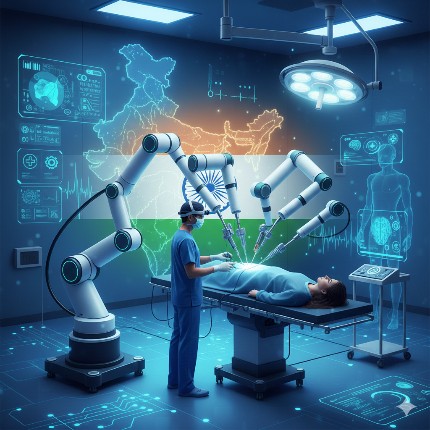
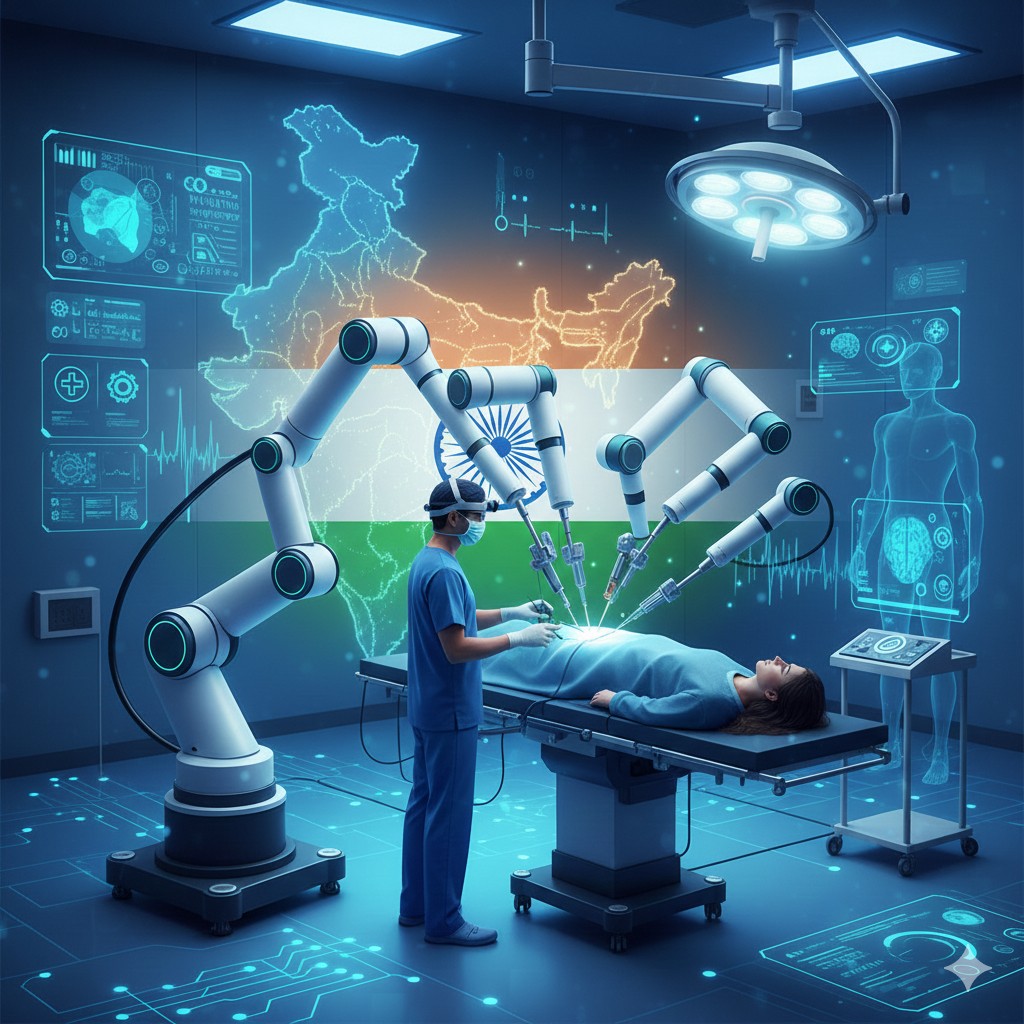
Robotic surgery in India has shifted quickly from a niche, luxury medical offering to a high-impact healthcare revolution driven by cutting-edge technology and rising adoption. At the core of this shift are advanced robotic systems such as Intuitive Surgical’s da Vinci platforms, which combine magnified 3D high-definition vision, wristed instruments that bend and rotate far beyond the human hand, and real-time motion control to extend a surgeon’s capabilities inside the body. The latest generation, da Vinci 5, dramatically increases computing power and introduces real-time feedback tools like Force Gauge, letting surgeons sense forces applied during tissue manipulation — a leap in precision and safety that can enhance outcomes and reduce complications.
🇮🇳 Current Status in India
Today, India ranks among the fastest-growing markets for robotic-assisted surgery in Asia. Hospitals across Delhi NCR, Mumbai, Chennai, Bengaluru, Hyderabad, and Pune routinely perform robot-assisted procedures using systems like the da Vinci Xi, which provide surgeons with true depth perception and crystal-clear 3D visualization, helping them work with surgical precision in delicate areas of the body. While Intuitive leads the market, competition is growing, and Indian innovators contribute to localized advancements.
Key Areas of Application
Robotic surgery now plays a leading role in:
-
Urology (e.g., prostate and kidney procedures)
-
Gynecology (e.g., hysterectomy)
-
Oncology (cancer-related surgeries)
-
General surgery (hernia, colorectal)
-
Cardiac procedures in select centers
Surgeons choose robotic systems because they combine minimal invasiveness with precision and control, allowing patients to benefit from smaller incisions, reduced trauma, and faster recovery.
How Robotic Surgery Works
Modern surgical robots act as extensions of the surgeon’s hands. The surgeon sits at a console, views the anatomy in 3D high definition, and controls robotic arms with superior dexterity and tremor filtration. These systems scale and translate the surgeon’s hand motions into fine robotic movements, enabling complex procedures that might otherwise require large open incisions.
Cost and Accessibility
Robotic surgery in India typically ranges from ₹2.5 lakh to ₹6 lakh per procedure, making it significantly more affordable than in many Western countries. However, the technology remains concentrated in private hospitals, and broader insurance coverage is still developing.
Industrial Robotics Influence: Fanuc India Pvt. Ltd.
Companies like Fanuc India Pvt. Ltd. may not produce surgical robots, but their expertise in high-precision motion, real-time control, and automation reliability influences the broader robotic ecosystem. Indian medical robotics developers and healthcare tech startups can draw on industrial robotics know-how to improve mechanical robustness and motion accuracy, helping build next-generation surgical tools that are both precise and cost-effective.
The Future: AI, Physical Robotics, and Humanoids
Looking forward, advances in Physical AI, edge computing, and high-speed connectivity will push surgical robotics beyond current limitations. Humanoid robotics platforms like Tesla’s Optimus, championed by Elon Musk, are drawing attention for their advanced perception and motion control technologies — capabilities that mirror what future surgical robots will require, even if Optimus is not designed for the operating room. By combining inspiration from platforms like Intuitive’s da Vinci systems, industrial research influenced by Fanuc India, and emerging AI trends, India is poised to move from being a major adopter of robotic surgery to a global innovator in AI-powered, physically intelligent medical systems.