
 Written by
 The streaming industry currently undergoes a massive transformation as Roku and Netflix redefine their roles in the digital living room. While Netflix once held an undisputed monopoly on viewer attention, Roku’s evolution into a sophisticated advertising platform now challenges that dominance. Investors and tech enthusiasts must track these shifting dynamics to understand which company actually controls the future of home entertainment in this high-stakes 2026 landscape.
The Strategic Shift: Platform vs. Content
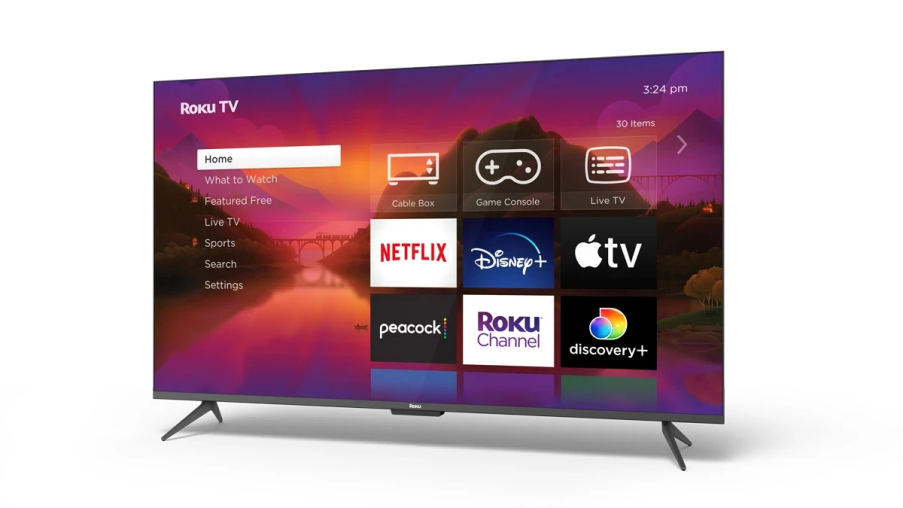
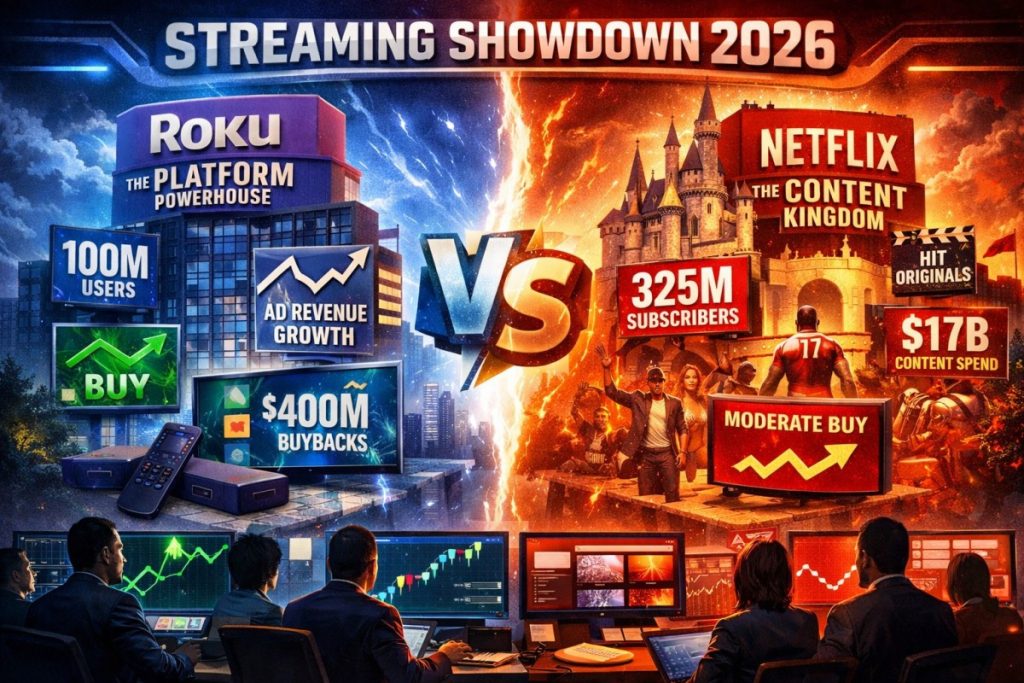
To understand the current “showdown,” one must first recognize that these two giants no longer compete for the same dollar. Netflix operates as a “Content Kingdom,” charging users for the privilege of watching premium, exclusive shows. In contrast, Roku functions as the “Digital Landlord,” owning the operating system (OS) that hosts Netflix and dozens of other apps.
While Netflix fights to produce the next global hit, Roku wins by simply being the gateway. This fundamental difference in business models creates a fascinating divergence in stock performance. Netflix remains the “blue chip” of streaming with unmatched global scale, but Roku offers a high-upside “growth” play within the booming Connected TV (CTV) advertising market.
Analyst Insights: The “Moderate Buy” Consensus
Recent market data from early 2026 reinforces a “Moderate Buy” sentiment for Netflix, as analysts from firms like BMO Capital and Oppenheimer maintain optimistic price targets. Wall Street currently views Netflix as the “gold standard” for execution, especially as it successfully scales its ad-supported tier to capture a broader demographic.
However, the broader communication services sector shows a stark contrast. While analysts remain bullish on Netflix’s ability to generate free cash flow, other players like FuboTV face a much steeper climb. FuboTV continues to struggle with high content acquisition costs for sports, leading many analysts to maintain a “Hold” or “Sell” rating on that specific ticker. For investors, this highlights a critical trend: the market is consolidating around “winners” like Netflix and Roku who have established scale, while niche players find it increasingly difficult to survive the “streaming squeeze.”
Roku’s Pivot to Platform Profitability
Roku recently shattered financial expectations by achieving consistent GAAP profitability throughout fiscal year 2025 and into the first quarter of 2026. This surge directly results from the company’s aggressive shift away from low-margin hardware toward high-growth platform revenue. Management reported an 18% year-over-year increase in platform earnings, fueled by a robust $400 million stock buyback program and the strategic integration of the Frndly TV acquisition.
This profitability signals a “coming of age” for the company. By moving beyond the “hardware puck” business, Roku now captures a significant portion of every ad dollar spent on its platform. Every time a viewer watches a free, ad-supported channel on a Roku-powered TV, the company takes a cut. This “toll-booth” model provides a more predictable revenue stream than the hit-or-miss nature of television production.
Expanding the User Ecosystem
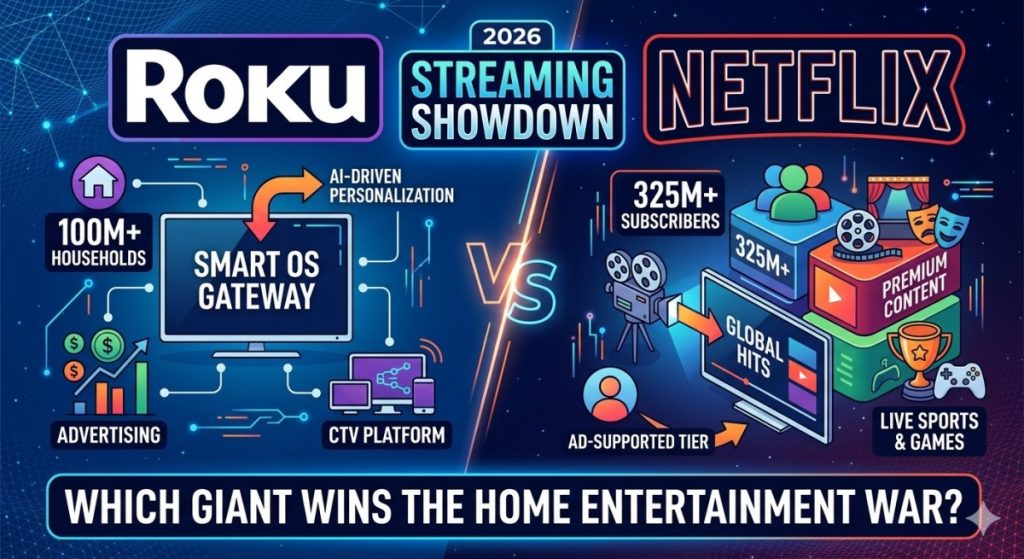
Beyond financial metrics, Roku’s massive scale solidifies its position as the leading TV operating system in North America. The platform now reaches over 100 million households, with The Roku Channel consistently ranking as a top-three engagement leader. This vast footprint creates a powerful feedback loop: higher user interaction attracts more premium advertisers, which in turn funds more exclusive content for the ecosystem.
Furthermore, Roku utilizes advanced AI-driven discovery to keep viewers on the screen longer. Its “Smart Snippets” and personalized content rows suggest shows across multiple apps, ensuring that the user never has a reason to turn off the television. By acting as the “brain” of the TV, Roku makes itself indispensable to the modern household.
Addressing Technical Roadblocks
Despite this growth, Roku faces persistent hurdles regarding hardware reliability and user experience. A recent viral trend involving “Roku TV connection issues” highlights the difficulty of maintaining a seamless interface across dozens of third-party TV brands like TCL and Hisense. While technical teams usually resolve these glitches via automated software patches and “Network Connection Resets,” the company must prioritize hardware stability.
These connectivity complaints serve as a reminder that a platform is only as good as its accessibility. If users perceive Roku-powered TVs as unreliable compared to Amazon Fire or Apple TV, the “Landlord” model begins to crumble. Consequently, Roku is investing heavily in its own “Roku Pro Series” TVs to set a gold standard for hardware performance.
Strategic Partnerships and Global Scale
Roku’s June 2025 partnership with Amazon fundamentally changed the advertising landscape by creating the largest authenticated CTV network in the United States. This collaboration allows advertisers to target audiences with surgical precision using data from both ecosystems. This synergy, paired with a rapid expansion into Mexico and Canada, gives Roku a diversified revenue stream that Netflix cannot easily replicate.
Market analysts maintain a “Buy” rating on the stock, noting that Roku’s infrastructure play offers a unique hedge against the volatility of the content-creation business. While a single bad season of a flagship show can hurt Netflix’s subscriber numbers, Roku profits regardless of which app the user chooses to open.
Netflix’s Content Counter-Attack
While Roku builds the “pipes,” Netflix continues to dominate the “water” with a subscriber base exceeding 325 million. Netflix’s 2026 strategy focuses on maximizing margins through its ad-supported tier and a deeper dive into live sports and gaming. By securing exclusive rights to major live events—including WWE and NFL holiday specials—Netflix forces viewers into its ecosystem, proving that premium content still dictates where the “streaming wars” are won.
Netflix has successfully pivoted from being a “disruptor” to being the “incumbent.” Its ability to crack down on password sharing and introduce a cheaper ad-tier has unlocked billions in new revenue. However, Netflix must spend nearly $17 billion annually on content to maintain this lead. This “content treadmill” requires constant innovation and a high tolerance for financial risk.
The 2026 Verdict: Innovation Wins
The ongoing shift from linear television to digital streaming favors both players, but for different reasons. The “Hormuz-style” squeeze on traditional cable TV means that billions of dollars in ad spending are migrating to the digital space every month. Roku wins by being the indispensable gateway for all apps, while Netflix wins by producing the culture-defining hits that viewers demand.
For market watchers and investors on WebKarobar, the real winner is the company that best utilizes AI-driven personalization to reduce “choice fatigue.” As we move further into 2026, Roku’s position as the primary operating system of the living room makes it a formidable contender against the content-heavy legacy of Netflix.
Investor Sentiment: Blue-Chip Stability vs. Platform Leverage
For investors evaluating the 2026 streaming battle, analyst sentiment points to two distinct paths for upside. Netflix (NFLX) currently carries a “Moderate Buy” consensus, with Wall Street price targets averaging near $112–$120 (and bulls like BMO targeting $135). This confidence stems from Netflix’s massive free cash flow, its successful exit from the Warner Bros. Discovery (WBD) acquisition pursuit, and a projected doubling of ad revenue to $3 billion this year. Major institutional powerhouses—including Vanguard, BlackRock, and Fidelity—maintain heavy stakes, reinforcing Netflix’s status as the low-volatility “blue-chip” leader of the sector.
On the other hand, Roku (ROKU) is increasingly viewed as a high-conviction growth play, with analyst targets surging toward the $125–$140 range (with Evercore recently raising to $150). This optimism reflects Roku’s dominant share of the Connected TV (CTV) market and its superior EBITDA-to-FCF conversion. While ARK Invest remains a top-three holder, recent filings show they have trimmed their position to reallocate into emerging AI, leaving the heavy lifting to institutional giants like Vanguard and State Street. For the strategic investor, the choice is clear: Netflix offers a battle-tested content fortress, while Roku provides pure-play exposure to the infrastructure and advertising upside of the digital living room.
Summary for Investors
- Netflix (NFLX): A “Moderate Buy” with unmatched global reach and a growing high-margin ad business.
- Roku (ROKU): A strong “Buy” for those seeking exposure to the CTV infrastructure and OS dominance.
- FuboTV (FUBO): A “Hold” as it struggles to balance niche sports content with rising operational costs.
Ultimately, the streaming showdown isn’t a “winner-take-all” game. Instead, it is a race to see who can provide the most seamless, personalized, and engaging experience for the modern viewer. Whether through Roku’s advanced ad-tech or Netflix’s blockbuster originals, the digital entertainment era is just getting started.