

 Written by
 The AI Moment Explained by Jensen Huang
Cutting Through the AI Hype of the AI Moment
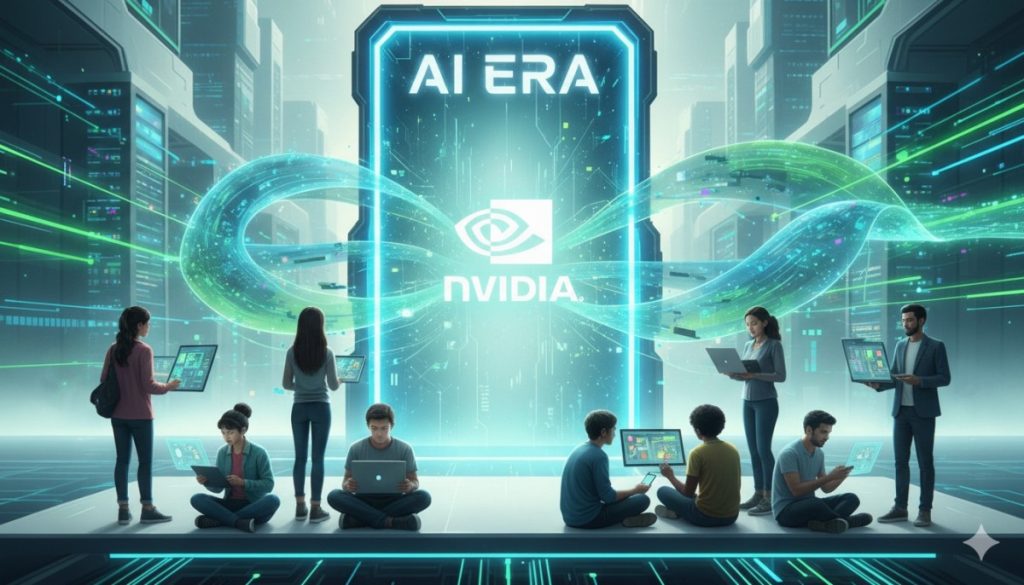
Nvidia’s CEO Jensen Huang highlights the AI moment and explains why it is crucial for early adopters. He has spoken frequently about how fast artificial intelligence is evolving and what that speed means for everyday people. While social media often exaggerates his words, his core message is clear: the AI moment is still open, accessible, and offers individuals a unique chance to grow before the space becomes fully industrialized.
AI Is Moving Faster Than Any Technology Before It
Jensen Huang often compares AI to the early internet, but today’s shift is unfolding much faster. Technologies that once took decades now evolve within months. AI-powered apps, businesses, and tools are spreading across writing, design, finance, healthcare, robotics, and automation at a pace most people have never seen. This rapid growth is why timing is so crucial for those who want to participate early.
The Backbone of AI Growth: Hardware, Systems, and Market Strength
Jensen Huang highlights that part of what makes the AI moment so powerful is the rapid pace of hardware innovation and the scale of supporting infrastructure. Demand for Nvidia’s Blackwell GPUs is staggering, sold out for the next 12 months, with the next-generation Rubin architecture planned for 2026. Nvidia now offers full data center-scale AI systems—GPUs, CPUs, networking, and cooling—all backed by its CUDA ecosystem, making it hard for competitors to catch up. Meanwhile, hyperscalers like Microsoft, Amazon, Google, and Meta are investing trillions into AI infrastructure built around Nvidia’s systems. Strong earnings, robust margins, and massive projected free cash flow reflect this demand. Together, hardware, software, and infrastructure are converging to create a rare AI moment of opportunity that won’t stay open forever.
From Chips to Complete AI Platforms
AI progress is no longer driven by chips alone. Huang has emphasized that modern AI depends on complete systems working together—compute, networking, software, and cooling operating as one. This system-level approach makes it increasingly difficult for competitors to catch up and explains why AI leadership is becoming more concentrated.
Why Individuals Still Have an Opening
Despite this concentration at the top, access at the ground level remains remarkably open. Powerful AI tools are now available to anyone with a laptop or phone. Students, freelancers, and small founders can build, automate, and launch products without needing massive teams or budgets. Huang highlights this moment because it represents a brief overlap: enterprise-scale investment on one side, and low barriers to entry on the other.
Timing Is the Real Opportunity
In simple terms, the door is open today because the infrastructure race is still underway. Major tech companies are spending enormous sums to build the backbone of AI, and that investment fuels rapid expansion across the ecosystem. But once this infrastructure matures, power will increasingly concentrate around those who own it. When that happens, competition will intensify, costs will rise, and breaking in as a small player will become much harder.
It’s Not a Deadline — It’s an Early-Stage Advantage
Huang is not warning of a hard cutoff date. Instead, he’s describing a familiar pattern: early phases reward curiosity, speed, and experimentation. Later phases reward scale and ownership. Just as the early internet created unexpected winners before consolidation set in, the early AI era is offering a similar head start.
The Simple Takeaway
Huang’s message is practical and optimistic: learn while tools are accessible, build while costs are low, and experiment while the field is still open. Those who move early won’t just adapt to the AI future—they’ll help shape it.