
 Written by
 The “Big Tech” Meltdown: A Structural Shift in the AI Economy
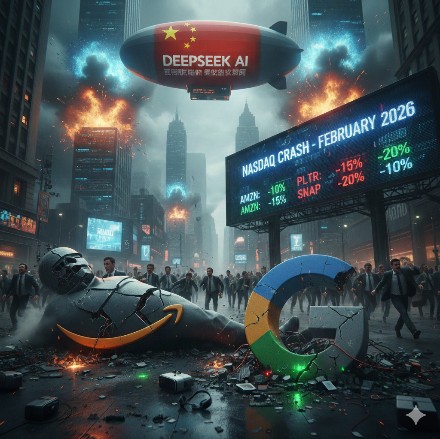
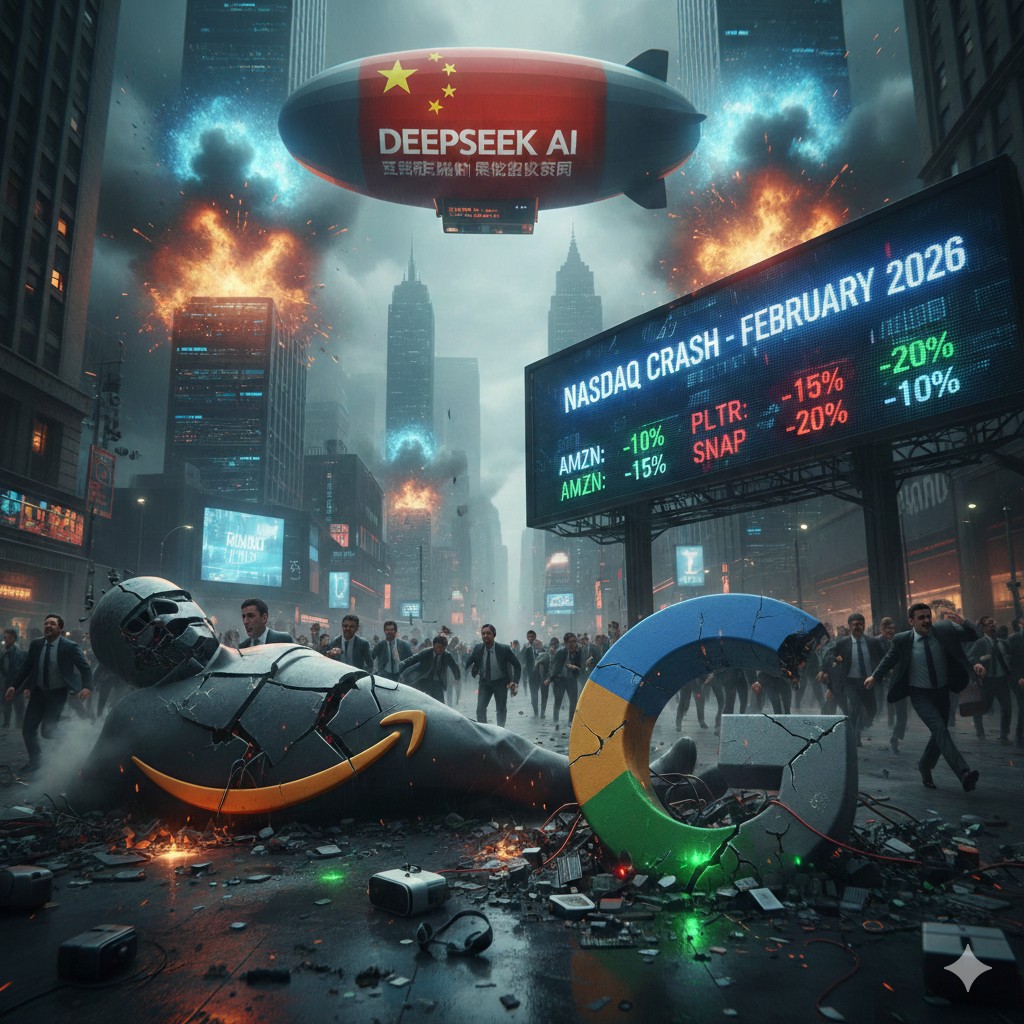
The “Big Tech” meltdown is no longer theoretical—it’s happening in real time, reshaping the financial landscape. On Thursday, February 5, 2026, the Nasdaq suffered its sharpest “reset” since the early AI boom. Amazon (AMZN) and Alphabet (GOOGL) led the sell-off, but the bigger story is a fundamental shift in how Wall Street values Artificial Intelligence.
Investors are moving from AI excitement to AI accountability. Spending on AI alone no longer earns rewards; now companies must show tangible returns. The era of “spend first, explain later” is over, and the era of measurable results has begun. The AI hype cycle is ending. Companies that cannot turn massive AI investments into profit now face intense scrutiny. Wall Street punishes reckless spending and rewards disciplined execution. This shift is driving the Capex arms race among U.S. tech giants, who are betting that infrastructure scale will decide winners and losers in the AI era.

The $200 Billion Shock: Amazon and Alphabet Lead the Capex Arms Race
This week’s market volatility is rooted in soaring Capital Expenditure (Capex). Amazon stunned investors by projecting a $200 billion spend for 2026, far above analyst expectations of $145 billion—a 54% year-over-year increase. The funds target hyper-scale data centers and next-generation Blackwell chips.
Alphabet followed with a doubling of infrastructure spending to $185 billion. Combined, the two giants plan to deploy nearly $400 billion into data centers, custom silicon, and power infrastructure.
CEOs Andy Jassy and Sundar Pichai call these investments “seminal opportunities” for long-term survival, but shareholders fear a massive drain on free cash flow. This Capex arms race prioritizes infrastructure over dividends and buybacks, leaving stock prices extremely sensitive to minor earnings misses.
Software-mageddon: AI Disrupts Traditional Software Models
Hardware makers like Nvidia (NVDA) and Micron (MU) benefit from infrastructure expansion, but software companies face what analysts call “Software-mageddon.” Autonomous AI agents can build applications or manage databases far cheaper than SaaS subscriptions, threatening traditional software revenue models.
Palantir Technologies (PLTR) illustrates this struggle. Despite 70% revenue growth, the stock fell nearly 7% as traders locked in profits. At over 300x earnings, any error triggers a sell-off. Investors are skeptical of “AI wrappers”—software that merely layers AI onto existing tools. Startups like Anthropic and OpenAI threaten to replace legacy platforms entirely.
Other affected companies include:
-
Salesforce (CRM) and Adobe (ADBE): Struggle as co-pilot features fail to generate meaningful revenue.
-
Snowflake (SNOW) and Datadog (DDOG): Face scrutiny as enterprises question costly third-party data layers in a world of self-optimizing AI agents.
The Snap Canary: Lessons for the Attention Economy
Snap Inc. (SNAP) dropped 13% to a 52-week low after losing 3 million daily active users in North America and Europe. Snap shows that AI features alone cannot save a platform—winning the “attention war” matters more than chatbots or co-pilot tools.
Meta and TikTok leverage energy-intensive AI recommendations to capture user time, leaving smaller players like Snap vulnerable. In the AI era, winners take all, and the middle tier of tech companies is disappearing. Only giants with capital to sustain billion-dollar AI models will survive.
Macro Headwinds: Tariffs, Jobs, and Crypto Volatility
The Big Tech meltdown occurs amid external economic pressures. New trade proposals threaten margins of global retailers. Estée Lauder (EL) fell 19% after tariff warnings, impacting tech companies with global supply chains, including Apple and Amazon.
A soft U.S. jobs report also fueled fears of a cooling economy. Consumer spending on premium tech gadgets and subscriptions usually drops when labor markets soften. Speculative assets like Bitcoin suffered as well—Coinbase (COIN) tumbled when Bitcoin fell 12% below $63,000, triggering broader sell-offs in high-beta tech stocks.
Buying Opportunity or Structural Shift?
Investors debate whether this is a healthy correction or a structural downturn. Bullish analysts, like Dan Ives at Wedbush, call it a “historic entry point” for Microsoft (MSFT) and Palantir. They argue the market overprices a “doom scenario” that doesn’t match robust enterprise AI demand.
Bears warn of a “Valuation Death Cross.” When AI Capex permanently exceeds AI ROI, shareholder math breaks down. Capital is rotating from speculative tech into defensive sectors, including healthcare leaders McKesson (MCK) and Ensign Group (ENSG), which hit record highs as tech stumbled.
Key Takeaways for Investors
To survive the tech reset, focus on companies with moats AI cannot easily breach:
- Vertical Integration: Alphabet and Amazon build their own chips (TPUs/Trainium), avoiding Nvidia’s high prices.
- Mission-Critical Data: Palantir controls AI infrastructure for government and military, irreplaceable by startups.
- Free Cash Flow Leadership: Avoid pre-revenue plays reliant on subsidies or debt.
The February 2026 Big Tech meltdown proves that even revolutionary technology must deliver results. The era of “blind faith” in AI is over; the era of “show me the money” has begun.
Global Competition Adds Pressure: China’s Efficiency Revolution
While U.S. giants engage in a Capex arms race, China is reshaping the AI landscape, creating a competitive backdrop that accelerates innovation. Chinese companies focus on efficiency and open-source dominance, contrasting with the U.S. strategy of sheer scale.
-
DeepSeek Shock & Open-Source Shift: Models like DeepSeek-V3 and Alibaba’s Qwen 3 now capture 30% of the working AI market. Open-weight models cost a fraction of U.S. proprietary alternatives and gain rapid global adoption.
-
Breaking the Silicon Noose: Huawei’s Ascend 910C controls 50% of China’s domestic AI chip market. Using Mixture-of-Experts (MoE) architectures, engineers extract high performance from less advanced hardware.
-
Policy Paradox: The U.S. may allow Nvidia to sell H200 chips to China with a 25% revenue tariff, enabling China to train AI on U.S. silicon while building a resilient, independent ecosystem.
Why it matters: China is not the main driver of U.S. Capex spending, but it adds global competitive pressure, highlighting the strategic importance of scale, infrastructure, and proprietary technology.
The AI Era Demands Results
The February 2026 Big Tech meltdown is more than a market correction—it signals a structural shift in the AI economy. Investors are no longer satisfied with promises and hype; companies must convert AI investments into measurable outcomes or face steep penalties. U.S. giants race to scale infrastructure, software models face unprecedented disruption, and global competition—particularly from China—adds pressure on efficiency and innovation.
Crypto markets underscore this shift. Bitcoin’s recent decline below $63,000 and the tumble of platforms like Coinbase reflect wider risk-off sentiment, highlighting how speculative assets and high-beta tech are the first to feel the impact when investors demand results.
For investors, the message is clear: focus on companies with defensible moats, mission-critical data, and sustainable cash flow. The era of “blind faith” in AI is over. The era of “show me the money” has officially begun.