
 Written by
 The Strait of Hormuz Handbrake – Why Global Oil Markets Are at Risk
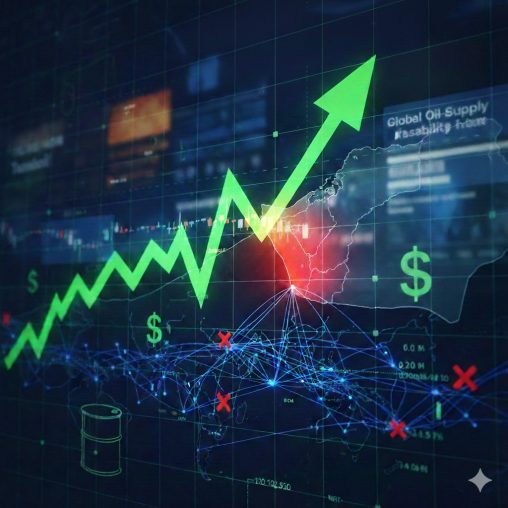
The Strait of Hormuz Handbrake has snapped into place, putting the global energy landscape on a razor’s edge. As of February 2026, this geographic chokepoint has transformed into a high-stakes arena of military and economic brinkmanship. While the “Agentic AI” boom has redefined how markets process data, the physical reality of oil transit remains tethered to a 21-mile-wide strip of water that carries over 20% of the world’s petroleum liquids. Today, investors aren’t just watching ticker symbols; they’re tracking satellite feeds and drone telemetry as the U.S. and Iran engage in a tense dance of “peace through superior firepower.”
The Incident: A Near-Miss in the Shipping Lanes
The current fever pitch began on February 3, 2026, when the Iranian Revolutionary Guard Corps (IRGC) aggressively approached a U.S.-flagged tanker, the Stena Imperative. In a move that shattered the relative calm of early winter, an Iranian Shahed-131 drone shadowed the USS Abraham Lincoln aircraft carrier, forcing a Marine F-35C to intercept and neutralize the threat—an unmistakable signal that The Strait of Hormuz Handbrake was in effect, testing global energy markets in real time.
This skirmish triggered an immediate “War Premium” in the oil markets. Brent crude futures, which analysts had projected to settle in a “Goldilocks” range of $60–$70 for 2026, spiked toward the $71 mark within hours. The message from Tehran was clear: if the West continues to push for “Sovereign AI” control and tighter trade restrictions, the world’s most vital energy artery can be clamped shut at a moment’s notice.
Market Psychology: The Great “Seesaw” of 2026
Currently, the market exhibits a peculiar behavior that traders call “Geopolitical Seesawing.” Following the drone shootdown, oil prices initially surged, but those gains were quickly erased when President Trump announced that high-level talks remained scheduled for Friday in Oman.
This creates a paradox for energy investors. On one hand, global production is forecasted to outpace demand by 3.2 million barrels per day this year. On the other hand, the “Hormuz Factor” introduces a variable that traditional supply-demand models cannot calculate. A total blockage of the Strait would remove nearly 20 million barrels per day from the market—an event that BloombergNEF warns could send Brent crude screaming toward $91 a barrel by late 2026.
The “Landlord” Strategy: Why U.S. Giants are Pumping
In this environment of “Fragmented Globalization,” where The Strait of Hormuz Handbrake continues to threaten global oil flows, sophisticated capital is fleeing “exposed” assets and rotating into “Safe Haven Energy.” Investors are aggressively buying U.S. oil giants that offer high production capacity far away from the Iranian coastline.
-
Occidental Petroleum (OXY): The Buffett Fortress Occidental is currently “pumping” in more ways than one. Shares have surged over 10.5% year-to-date as of February 2026, significantly outperforming the S&P 500. Investors are following the lead of Warren Buffett’s Berkshire Hathaway, which now owns nearly 26% of the company. OXY is the ultimate “Permian Basin” play; because its primary assets sit in the heart of Texas and New Mexico, it is physically insulated from Middle Eastern instability. Furthermore, with the multi-billion dollar sale of its OxyChem division to Berkshire closing this quarter, OXY is aggressively shedding debt, making it a favorite for “Landlord” investors seeking a clean, high-margin balance sheet.
-
Chevron (CVX): The Record Breaker Chevron is exhibiting a “bullish acceleration” that has pushed the stock toward all-time highs of $176.90 this February. The company recently shocked the market with a Q4 earnings beat (EPS of $1.52), driven by record-breaking production of 4.1 million barrels per day. Like OXY, Chevron is leaning heavily into its U.S. shale assets while integrating its massive Hess acquisition. By raising its dividend 4% to $1.78 per share, Chevron has signaled to the market that even if the Strait of Hormuz remains volatile, its cash machine is untouchable.
The AI-Energy Nexus: A New Secular Growth Story
We are also seeing the rise of a new category: AI-Energy Stocks. As data centers for AI agents demand 24/7 “baseload” power, companies like GE Vernova (GEV) have become the standout “Alpha” of 2026. Up over 470% since its spinoff, GEV provides the natural gas turbines and grid equipment necessary to power the “Agentic Web.” This provides a growth story that is less dependent on the daily price of crude and more dependent on the relentless expansion of the AI economy.
💵 Why the US Dollar Is Up
-
Geopolitical risk (such as tensions involving Iran and the Strait of Hormuz) often drives investors into safe‑haven assets, and the U.S. dollar is seen as one of those safe havens. That tends to push the dollar higher against other currencies.
-
Recent market data show a firmer U.S. dollar has weighed on commodities like oil and gold because a strong dollar makes those dollar‑priced assets more expensive for buyers holding other currencies.
The Oman Pivot: What Happens on Friday?
The world now holds its breath for the Oman summit. The diplomatic “Aura” surrounding these talks will determine the direction of the global economy for the rest of the quarter.
If the talks yield a “Tariff Truce” or a de-escalation agreement, expect the $3–$4 “War Premium” to evaporate instantly. Oil would likely slide back toward $65, and high-flying stocks like Chevron and Occidental might see a healthy correction as traders “sell the news.” However, if the talks fail and Iran follows through on its threat to “interdict” tankers, we are looking at a structural shift. In that scenario, energy stocks will cease to be “commodities” and start behaving like “Defense” stocks, rallying on the necessity of survival rather than the logic of profit.
Navigating the “Agentic” Energy Era
As we navigate the complexities of 2026, the lesson for every startup founder and investor is the same: Sovereignty is the new currency. Whether it’s running your own Llama 3.3 models to avoid “AI Rent” or investing in Occidental to avoid “Hormuz Risk,” the goal remains to reduce dependency on fragile, centralized chokepoints.
The energy market isn’t just “hot”—it is undergoing a fundamental transformation. While AI agents handle our trades and our SEO, they still require the raw, physical power of the grid to function. And right now, that power is being contested in the 21 miles of the Strait of Hormuz.