
 Written by
 Meet LWLG Stock: The Tech Investors Can’t Ignore
Published: March 26, 2026 | Updated: June 14, 2026
LWLG stock (Lightwave Logic, NASDAQ: LWLG) is a U.S.-based photonics company capturing investor attention with its proprietary electro-optic (EO) polymer technology. The company develops materials designed to accelerate data transmission while reducing energy consumption, positioning itself as a potential leader in AI, 5G, and data center infrastructure.
In 2026, the company strengthened this positioning through a strategic partnership with Tower Semiconductor, marking a key shift from a development-stage firm to a commercially viable AI infrastructure player. Building on this technical foundation, LWLG stock achieved a decisive shift toward commercial validation as the company reported a 147% year-over-year revenue increase in 2025. This momentum accelerated dramatically into mid-2026, pushing LWLG stock to a fresh 52-week high of $18.71 following a major sector-wide AI hardware rally and key progress with their tier-1 customer pipeline. Supported by robust liquid assets that reached $75.1 million as of Q1 2026 (with cash on hand rising to $100 million by May 11, 2026), Lightwave Logic is aggressively leveraging its capital to transition from an R&D framework into a commercially ready manufacturing contender within the high-speed optical hardware market.
This transition has gained further credibility in 2026 as Lightwave Logic’s technology begins integrating into real semiconductor manufacturing platforms, reinforcing its commercial adoption potential.
2025 Financial Highlights
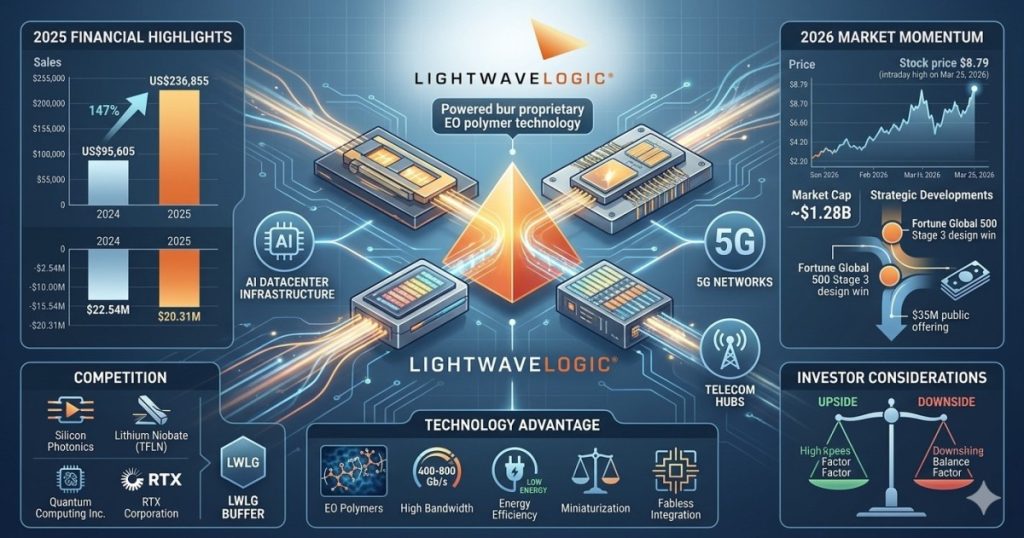
In 2025, Lightwave Logic achieved sales of US$236,855, up from US$95,605 in 2024, marking a 147% year-over-year increase. Although revenues remain modest, this growth demonstrates early commercial traction and engineering progress, providing a fundamental spark for LWLG stock.
Simultaneously, the company narrowed its net loss from US$22.54 million to US$20.31 million, and loss per share improved from US$0.19 to US$0.16. These improvements reflect efficient operational management despite ongoing development-stage investments. The results highlight a company steadily advancing toward commercial viability, signaling cautious optimism for investors.
2026 Market Momentum
LWLG stock has seen explosive momentum throughout the first half of 2026, fueled by the expansion of its semiconductor foundry ecosystem and an intense sector-wide rally in AI-driven data infrastructure. While the stock maintained a baseline range around $7.76 to $8.21 in early April, it experienced a massive multi-session technical breakout later in the spring, climbing past $13.72 by late April and peaking at an intraday high of $18.71 by mid-May 2026. This aggressive movement pushed the company’s valuation metrics to new heights as investors react to the company’s dual-foundry strategy involving Tower Semiconductor and GlobalFoundries.
Several developments support this momentum:
-
Commercial Milestones: A Fortune Global 500 customer recently progressed to Stage 3 of its design win cycle, joining four other major industry players currently in the advanced evaluation phase for mass-market adoption.
-
Capital Strengthening: A $35 million public offering in late 2025 provided the liquidity to move from development to commercialization.
-
Sector Interest: Growing demand for high-speed, low-power data transmission in AI, 5G, and data centers has increased investor attention toward companies with advanced photonics materials.
AI-driven workloads are now accelerating this demand further, positioning Lightwave Logic as a potential enabler of next-generation data center performance.
Lightwave Logic develops high-performance electro-optic (EO) polymers that convert electrical signals into optical data at extreme speeds. As AI systems in 2026 demand faster, more energy-efficient data transfer, these polymers provide a critical alternative to traditional silicon-based interconnects.
The company’s technology excels through several key advantages:
-
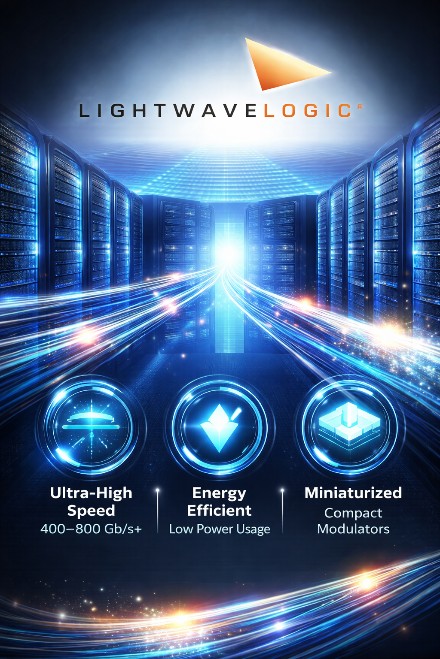
Ultra-High Bandwidth: The platform supports data rates of 400–800 Gb/s and beyond, consistently surpassing the physical limits of conventional modulators.
-
Superior Energy Efficiency: These polymers consume significantly less power than silicon or lithium niobate. This efficiency directly reduces operational costs for large-scale AI data centers and global telecommunications hubs.
-
Aggressive Miniaturization: The compact design of these modulators allows engineers to pack more high-speed lanes into space-constrained environments without increasing the hardware footprint.
Technology Overview
To scale these benefits, Lightwave Logic employs a “Fabless” Integration strategy:
By offering a standardized Process Design Kit (PDK) through platforms like GDSFactory, LWLG integrates its polymers into established CMOS-compatible foundry flows, such as those at GlobalFoundries and Tower Semiconductor. This “plug-and-play” approach enables chip architects to “drag and drop” high-speed modulators directly into their designs using standard industry software. Consequently, this lowers the barrier to mass-market adoption and allows the company to scale rapidly without the multi-billion-dollar capital expense of building dedicated fabrication plants.
Furthermore, the company utilizes a high-margin Licensing Model:
This model allows global manufacturers to integrate LWLG’s proprietary polymers without heavy capital investment. By licensing the technology and supplying the specialized materials, Lightwave Logic accelerates market adoption while maintaining a lean, scalable business structure.
2025 Results and Investment Narrative
The underlying investment thesis for Lightwave Logic evolved significantly following their mid-May 2026 business update. Driven by massive infrastructure acceleration for 1.6T and 3.2T optical transceiver architectures in generative AI datasets, management officially increased their estimated near-term Serviceable Addressable Market (SAM) to a newly projected range of $2 billion to $4 billion (up from the previous $1 billion to $2.5 billion estimate). While actual Q1 2026 revenues remain baseline-level at $29,167 alongside a quarterly net loss of $6.30 million, the massive expansion of their addressable market—paired with an operational runway fully funded through late 2027—has fundamentally strengthened the long-term commercial outlook for growth-oriented hardware investors.
Competition and Market Dynamics
Lightwave Logic operates in a competitive landscape that includes silicon photonics and lithium niobate (LiNbO₃) technologies, particularly thin-film lithium niobate (TFLN) photonics. Key competitors include:
Quantum Computing Inc.: Developing TFLN photonic chips for AI and quantum systems.
RTX Corporation: Producing TFLN wafers for telecom and defense applications.
Silicon Photonics Companies: Established players delivering dense wavelength-division multiplexing (DWDM) and high-volume integrated photonic circuits.
These technologies are well-established and widely deployed, creating a strong competitive environment.
This competition is intensifying further in 2026 as AI-driven demand accelerates innovation across the photonics sector.
Silicon photonics offers proven reliability and high-volume integration, while lithium niobate provides ultra-low optical loss, high linearity, and long-distance performance.
Despite these competitors, Lightwave Logic’s EO polymers offer distinct advantages, including higher bandwidth, lower power consumption, and smaller form factors. These features are especially valuable for dense data centers and telecom hubs, where efficiency and space savings matter.
However, competitors could potentially replace Lightwave Logic in partnerships if they deliver better performance, lower costs, or faster adoption. At the same time, the growing AI, 5G, and data center market allows multiple players to thrive. Lightwave Logic benefits from a first-mover advantage, early design wins, and strategic licensing agreements that provide a protective buffer against replacement, at least in the short term.
June 2026 Update: Market Positioning
As of mid-June 2026, Lightwave Logic’s valuation has consolidated following the volatility observed in the broader semiconductor sector throughout May. While the stock has retreated from its mid-May intraday high of $18.71, the company continues to advance its core strategic objectives, including the successful deployment of its Version 1.1 Polymer Photonics PDK. With its operational runway now secured through late 2027 and its technology integrated into the foundry ecosystems of both Tower Semiconductor and GlobalFoundries, the company remains in a transition phase. For investors, the current market pricing reflects a “wait-and-see” approach, as the industry looks for further milestones in high-volume design wins to substantiate the company’s long-term commercial potential within the rapidly expanding 1.6T and 3.2T optical transceiver markets.
Insider Activity and Market Cooling
Despite strong technological tailwinds, Lightwave Logic experienced a wave of routine insider stock dispositions in early April 2026. Rather than indicating an intentional structural exit or a decline in management conviction as shares gained forward momentum, these transactions strictly reflect automated, non-discretionary portfolio adjustments. Specifically, SEC Form 4 filings confirm that these liquidations were executed automatically under standard corporate schedules to satisfy immediate tax withholding obligations generated by the vesting of restricted stock units (RSUs) on March 31, 2026. Because these “sell-to-cover” actions are programmatic features of executive equity compensation, the core leadership team remains heavily aligned with Lightwave’s multi-year foundry rollout and intellectual property commercialization timeline.
On April 10, 2026, CFO Snizhana Quan sold 20,000 shares for approximately $207,200 at an average price of $10.36. Earlier, on April 7, 2026, Director Siraj El-Ahmadi sold 54,536 shares worth $423,199. In addition, Director Thomas M. Connelly Jr. sold 9,000 shares on April 6, 2026.
While these transactions may appear significant at first glance, SEC filings show that most of the selling—particularly from directors—occurred as sell-to-cover transactions to meet tax withholding obligations tied to vested equity awards. In other words, the sales were largely mechanical rather than discretionary.
These mechanical liquidations do not reflect a decline in management conviction; the core leadership team remains heavily aligned with Lightwave’s multi-year commercialization timeline.
Quick Fact-Check (For Reference)
- CFO Snizhana Quan sold 20,000 shares on April 10, 2026, totaling ~$207,200
- Director Siraj El-Ahmadi sold 54,536 shares on April 7, 2026, totaling ~$423,199
- Director Thomas M. Connelly Jr. sold 9,000 shares on April 6, 2026 (~$76,680)
Most of these transactions (excluding potential discretionary sales) were sell-to-cover actions related to taxes on vested stock awards, which is standard corporate compensation practice.
Investor Considerations
Investors weigh risk versus opportunity when evaluating Lightwave Logic:
Upside: Unique EO polymer technology, early traction with major partners, and a rapidly expanding photonics market.
Downside: Competition from silicon photonics and lithium niobate, small current revenues, and ongoing operational losses.
Investors are essentially betting on the company’s future potential, rather than current earnings. Lightwave Logic’s technical differentiation, first-mover advantage, and strategic partnerships make it a high-risk, high-reward opportunity in next-generation optical communications.
Final Take
For investors, the opportunity lies in capturing the expanding AI and data center market through a company that is transitioning from research to real-world deployment. With growing semiconductor partnerships and increasing relevance in AI infrastructure, Lightwave Logic is evolving into a high-risk, high-reward bet on the future of high-speed data transmission, while still carrying execution and competitive risks.