
 Written by
 Why Investors See WELL Health Undervalued
WELL Health Technologies (TSX: WELL) has proven itself to be a magnificent yet fundamentally mispriced entity, emerging as one of Canada’s most compelling healthcare growth stories. Despite relentless financial performance—marked by record-breaking quarterly revenue, expanding operating margins, and rapid, accretive clinic optimization—the company’s stock price continues to lag significantly behind its operational momentum. While the public healthcare infrastructure across North America grapples with severe primary care shortages, clinician burnout, and deep digital inefficiencies, WELL is systematically scaling both its physical clinic footprint and its digital-health ecosystem simultaneously. The growing gap between WELL Health’s intrinsic fundamental performance and its public market valuation is becoming increasingly difficult for institutional and retail investors to ignore, making it a standout narrative for those seeking undervalued growth stocks.
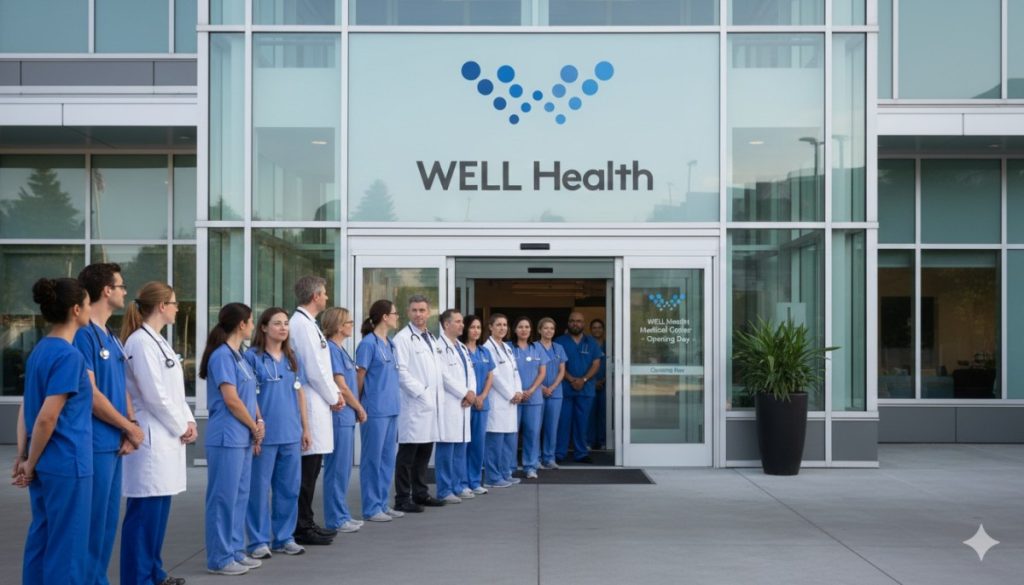
WELL Health Acquires OID Group and UnionMD
The primary driver behind the current “undervalued” thesis is WELL Health’s recent acquisition of the OID Group and UnionMD, which marks an aggressive pivot away from lower-margin medical structures and into high-margin specialized clinical verticals.
With this coordinated, multi-province expansion, WELL Health has acquired two highly profitable, strategic entities:
-
The OID Group (Ontario Imaging Diagnostics): WELL Health acquired this premier network of outpatient diagnostic imaging clinics operating across Ontario, which specializes in high-demand modalities such as X-rays, ultrasounds, and bone density scans.
-
UnionMD: WELL Health acquired a 65% controlling interest in one of Québec’s largest, fastest-growing multi-disciplinary, procedure-first healthcare platforms.
Together, these newly acquired networks generated approximately $22 million in annualized Adjusted EBITDA on an isolated basis in 2025, operating at stellar margins comfortably north of 25%. By weaving complex diagnostic imaging and advanced procedural care directly into its pre-existing primary care architecture through these landmark acquisitions, WELL Health has established a highly lucrative diagnostics ecosystem. Patients can now seamlessly progress from an initial primary care consultation or virtual triage environment (such as WELL’s CardiologyNow network) directly into a newly acquired, company-owned diagnostic facility for rapid testing and imaging. This internal loop captures the entire clinical value chain under one digital roof, radically expanding the enterprise’s revenue per patient visit.
A Rapidly Expanding Canadian Doctor Network
The foundation of WELL Health’s compounding organic traction stems from its deeply integrated physician network. According to the company’s latest public disclosures and mid-year operational reports, WELL now directly employs or partners with over 1,400 physicians across Canada, a figure that represents roughly 1.2% to 1.3% of the nation’s entire practicing doctor population.
System-wide, when factoring in the company’s expanding Allied Health professionals, the breadth of its clinical ecosystem has climbed to approximately 2,350 billable healthcare providers and more than 4,700 total care professionals across physical and virtual storefronts.
Furthermore, WELL’s expansive Software-as-a-Service (SaaS) and digital infrastructure now touch more than 44,000 healthcare practitioners nationwide. This implies that nearly 40% of all Canadian physicians engage with WELL’s technology ecosystem to manage bookings, fulfill charting requirements, or optimize clinic operations. These transparent provider metrics are sourced directly from regulatory filings, making them some of the most reliable and highly verifiable lagging indicators of the company’s true ecosystem market share.
Regional Footprint and AI-Driven Efficiencies
Following the successful onboarding of the OID Group and UnionMD platforms, WELL’s brick-and-mortar footprint has expanded to approximately 270 physical clinics coast-to-coast, heavily concentrated in Canada’s highest-density healthcare markets: Ontario, Alberta, and Québec.
Key regional hub clinics, including locations such as Fleetwood, Panorama Village, and Lonsdale, serve as the operational blueprinted standard for local care delivery. Fleetwood serves as a high-volume hub for multi-doctor family medicine and primary triage, while Panorama Village provides comprehensive multi-specialty services tightly integrated with WELL’s advanced digital suite. Lonsdale addresses urban demand through an agile mix of walk-in, urgent care, and specialized telehealth protocols.
Simultaneously, WELL is driving clinical innovation through its strict technology partnerships, most notably with HEALWELL AI (TSX: AIDX). By deploying proprietary AI tools such as the WELLTRUST secure ecosystem and DARWEN AI, WELL is fundamentally altering the cost structure of running a medical practice by automating back-office workflows, optimizing document routing, and dramatically speeding up the generation of diagnostic and imaging interpretations.
       WELL HEALTH TECHNOLOGIES: FINANCIAL TRAJECTORY (Q1)

       $400M +----------------------------------------+
             |                                        |
       $300M |                       $368.3M          |
             |                      +-------+         |
       $200M |                      |       |         |
             |       $294.6M        |       |         |
       $100M |      +-------+       |       |         |
             |      |       |       |       |         |
         $0M +------+-------+-------+-------+---------+
                         Previous Year      Current Year
Surging Productivity and Record Financial Metrics
The bears’ narrative that physical clinical networks cannot achieve software-like operating leverage is being actively disproven by WELL’s productivity data. Driven by the aggressive deployment of AI-powered ambient scribes and automated voice-to-text workflows, providers handled an average of 576 patient visits per billable practitioner in the most recent quarter.
The underlying efficiency mechanics are stark: WELL’s clinics automated the transcription, categorization, and digital mobilization of roughly 195,000 legacy fax images via AI within a ninety-day window. Physicians actively utilizing these integrated ambient AI tools report reclaiming up to 10 hours per week previously lost to administrative burdens, directly converting those saved hours into higher patient throughput and vastly improved quality of care.
This optimization is feeding directly into a highly efficient financial growth engine. In its latest quarterly earnings release, WELL posted:
-
Quarterly Revenue: $368.3 million, marking a robust 25% increase year-over-year.
-
Adjusted EBITDA: $43.1 million, showcasing a massive 56% surge year-over-year.
-
Adjusted Net Income: $15.5 million, more than doubling its profitability over the prior comparative period.
-
Adjusted Gross Margin: Expanding steadily to 44.3%, bolstered heavily by higher-margin diagnostic imaging, WELLSTAR, and HEALWELL allocations.
More impressively, on the back of its summer acquisitions, WELL officially announced it achieved its long-standing corporate milestone of a $100 million annualized Adjusted EBITDA run-rate ahead of schedule. The standalone Canadian Clinics unit alone has been propelled to a run-rate exceeding $80 million in annualized Adjusted EBITDA. Because of this high-margin performance, management revised its corporate outlook, indicating it expects to comfortably beat the top end of its full-year Adjusted EBITDA guidance range of $175 million to $185 million, anchored by solid full-year revenue targets between $1.55 billion and $1.65 billion.
Balancing Ambitious Targets with Market Realities
While the numbers paint a compelling picture, prudent growth investors must maintain a balanced perspective regarding the company’s long-term objectives. WELL’s overarching macro goal—capturing a 10% share of Canada’s entire physician base over the coming decade—remains an incredibly steep, capital-intensive mountain to climb. It will require flawles execution of physician recruitment strategies and unmitigated retention across highly fragmented regional regulatory environments.
Furthermore, the integration of massive medical imaging structures under newly appointed Chief Operating Officer Derek Clark—who brings deep institutional compliance pedigree from GE Healthcare and Calian Group—must be executed without operational friction. The market will continue to scrutinize WELL’s balance sheet leverage against its senior secured credit facility, alongside the time lag required for its explosive top-line and Adjusted EBITDA numbers to consistently translate into pure, unadjusted IFRS net positive profitability.
Absorbing Unpredictable Public Health Demand
The underlying fundamental demand for WELL’s modernized infrastructure is further highlighted by the systemic pressures facing traditional healthcare systems. Across North America, medical networks face severe, highly volatile seasonal spikes driven by localized community health outbreaks, such as unexpected resurgences in aggressive norovirus strains or severe respiratory syncytial viruses that often track well above traditional five-year historical averages.
When these surges impact dense, metropolitan clinical areas, un-optimized legacy systems face administrative failure and severe patient wait times. WELL’s digital routing infrastructure, integrated instant-access e-consult platforms, and centralized workflow orchestration give it the unique ability to absorb, triages, and process massive, irregular patient volumes dynamically, demonstrating the resilience and societal necessity of its platform.
Final Take: The Valuation Disconnect
What is no longer a matter of speculation is the highly visible, self-sustaining financial momentum anchoring WELL Health Technologies today. Supported by a newly fortified diagnostic imaging network, expanding practitioner counts, soaring per-provider productivity, and an advanced AI ecosystem, the company is fundamentally outperforming its stock price. Despite managing over 1.9 million total patient interactions system-wide each quarter, WELL’s public market valuation continues to trade at a steep discount to its technology peers and healthcare consolidator competitors. For forward-looking investors, this clear disconnect represents a classic, mispriced growth opportunity that the market cannot ignore forever.