
 Written by
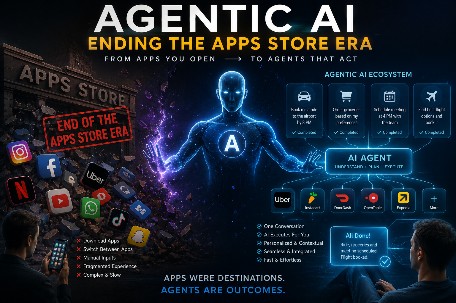
 Agentic AI Takes Over Apps and the App Store
A major shift is underway in how software is accessed, executed, and experienced. In an emerging agentic AI and agent-driven world, traditional applications are losing their role as primary user interfaces. Instead, they are evolving into backend systems that expose data and functionality to AI agents.
Rather than being destinations users actively open, apps increasingly function as service layers that AI systems can call, combine, and execute on behalf of users.
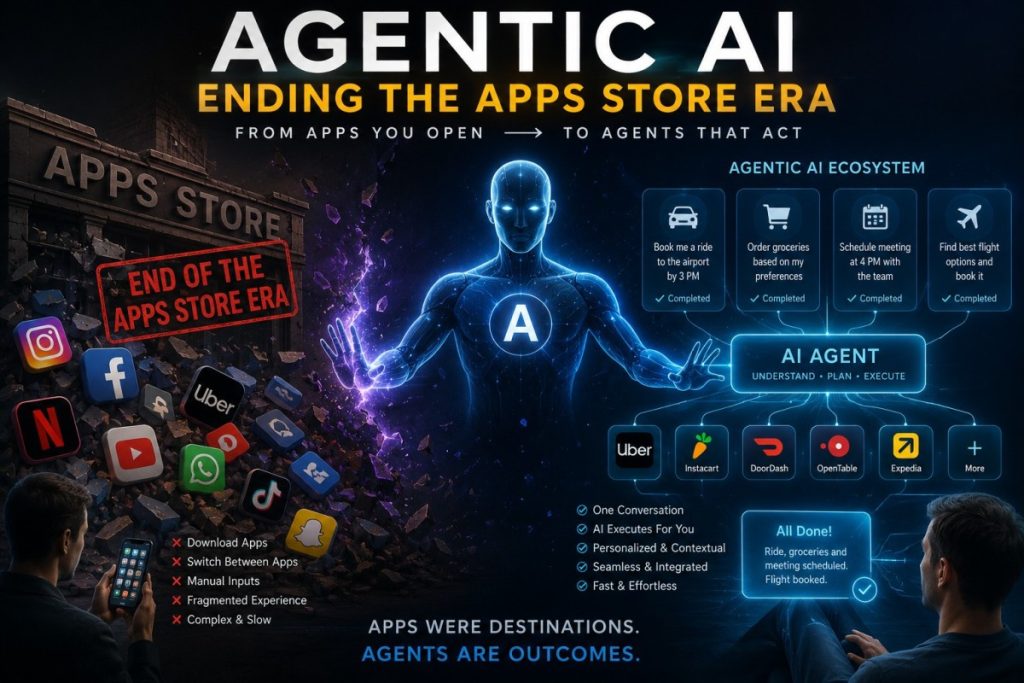
The Shift from Apps to Agents
This transition becomes clearer when comparing today’s interaction model with the emerging agentic approach:
The Old Way:
You open Uber → enter a destination → select a ride → switch to Apple Pay → authenticate manually.
The Agentic Way:
You say: “Book me a ride to the airport by 3 PM.”
The AI evaluates traffic, queries multiple ride platforms through APIs, selects the optimal option, and completes the transaction securely.
This shift is already being enabled by infrastructure such as Android AppFunctions and protocols like MCP (Model Context Protocol), which allow AI agents to discover and execute functions inside third-party applications without requiring users to open them.
Who Gains Power in an Agent-First Ecosystem
As users stop interacting with app grids, the traditional Silicon Valley value chain begins to restructure.
The company controlling the primary AI interface becomes the new gatekeeper of digital life. Instead of users selecting apps directly, they express intent to an assistant, which routes tasks across services.
For example, when a user requests “order groceries,” the AI determines whether to use Instacart, Walmart, or a local provider based on pricing, partnerships, and availability.
This creates a new control layer where intent routing becomes more valuable than app distribution.
The App Store Evolves Into an Agent Store
The traditional App Store model is not dying; it is changing how it works to stay secure. Apple and Google do not allow AI to rewrite code or change app behaviors on its own because that creates massive security risks.
Instead, tech platforms are shifting their app stores into verified registries of safe AI actions. They require developers to build structured, secure connectors called App Intents (or AppFunctions on Android).
As this system develops, you will still download or connect services to your account, but you will no longer need to manually open and navigate their visual screens. Instead, those services will plug directly into your device’s main AI assistant using these secure backend hooks.
This completely changes how discovery works:
-
The Old Way: You browse the App Store, read reviews, and manually choose which app to open.
-
The New Way: Your AI assistant automatically searches a trusted backend registry and securely routes your request to the service that best matches your personal preferences, budget, and history.
In the end, tech companies do not lose control. Their role simply shifts from distributing visual apps to managing a secure gateway that controls how AI systems talk to background services.
Generative Interfaces Replace Static UI
As AI agents handle more tasks, traditional app interfaces become less important. Instead of forcing a user to open a full application, systems deploy Generative UI—creating simple, temporary interfaces only when they are needed.
For example, when booking a flight or comparing products, the AI may dynamically compile a small visual widget with just the key options or a final confirmation button. These interfaces are generated on the spot, render in real time, and completely disappear once the task is finished. As a result, software becomes fluid, contextual, and less visible to the user.
Why Traditional Apps Will Still Matter
Even though AI agents are becoming more common, traditional apps will still be very important. This is because some tasks need accuracy, control, and detailed interaction that AI cannot fully handle on its own.
Work like 3D design, financial modeling, video editing, and data analysis requires users to directly see and control what they are doing in real time. AI agents cannot fully replace this without losing detail or precision. The same is true for gaming and simulation, where users need fast responses and full control during the experience.
AI agents will take care of simple and repetitive tasks, but apps will still be used for complex work. In the end, apps will remain important tools where users need full control and accuracy.
Trust, Security, and Liability Limit Full Autonomy
Even as AI agents become more capable, trust, security, and legal risks still limit full automation in sensitive tasks. These risks become especially important when systems handle money transfers, healthcare decisions, enterprise operations, or personal data, where even small mistakes can lead to serious consequences.
To manage these risks, systems add multiple safety layers. They require user permissions, enforce human approval for critical actions, and maintain detailed audit logs that track every step. These safeguards ensure that every action can be reviewed, verified, and traced when needed.
As a result, AI agents do not act with full freedom in high-risk areas. Instead, they operate within strict boundaries, especially in regulated industries where compliance, accountability, and control remain essential.
The Deterministic Backend Remains Essential
While AI agents excel at interpreting intent and planning actions, they operate on probabilities—meaning they can make mistakes, hallucinate, or produce unreliable outputs. Because of this, they cannot be trusted to directly handle critical operations like core banking updates, healthcare data changes, or enterprise transactions.
That is why backend systems must remain strictly deterministic. They enforce uncompromising security rules and maintain unchangeable audit logs to ensure that every action is predictable, safe, and compliant.
This creates a clear division of roles:
-
The AI Layer: Interprets what the user wants and organizes the workflow.
-
The Backend Layer: Securely executes the transaction and enforces the rules.
Together, they combine cognitive intelligence with absolute backend reliability.
The Shift to Agent-Ready Infrastructure
This strict separation of roles is fundamentally changing how software is engineered. Market value is shifting rapidly away from client-side visual layouts and click-optimization toward building backend systems designed specifically for machine consumption.
Instead of optimizing applications for human eyes and screen real estate, development teams are pivoting to build structured APIs, robust semantic schemas, and clean execution layers that autonomous AI agents can easily discover, read, and interact with in real time.